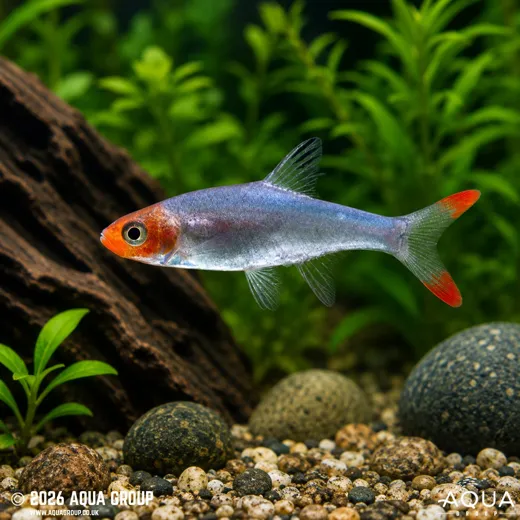
Asian Rummynose Rasbora
An unusual scaleless minnow with a silver body, a red-tipped snout and red tail lobes on the males. Distinctive, uncommon, and better suited to cooler harder water than most of its relatives.
Feeding
Small flake, micro-pellets and frozen cyclops, daphnia and baby brine shrimp.
Compatibility
Peaceful but easily outcompeted. Best in a species tank or with other calm species that share its preference for cooler, harder water. Keep in groups of ten or more.
Behaviour and personality
Active, loosely shoaling, with males displaying to one another in open water.
Water Requirements
| Parameter | Requirement |
|---|---|
| Temperature | Cooler water, ideally 18–22°C |
| Water Hardness | Hard water, preferably above 8 dGH |
| Water pH | Alkaline, ideally 7.0–7.8 |
FAQ
What kind of water conditions do Asian Rummynose Rasboras prefer?
They thrive in cooler, harder, alkaline water. Temperatures between 18–22°C and water hardness above 8 dGH are ideal. They perform poorly in warm, soft water.
How should I feed my Asian Rummynose Rasbora?
Feed small flake food, micro-pellets, and frozen foods such as cyclops, daphnia, or baby brine shrimp.
Can I keep Asian Rummynose Rasboras with other fish?
They are peaceful but easily outcompeted. Best kept in a species tank or with other calm, similarly water-conditioned fish. Group size of ten or more is recommended.


Andrea Young –
The fish are very active and show off their red tail lobes when in groups. I kept them in a 20-gallon tank with hard water and cool temperature. They’ve been thriving for over six months. Only issue is they need stable water conditions or they become stressed.
Jason Clark –
First time keeping rasboras and this one stood out. The males are quite colorful and display in open water. I had to adjust my water hardness to 9 dGH and keep it cool. They’re not hard to care for once the conditions are right.
Julia Butler –
They look beautiful in a group, but I found they don’t do well in soft water. I had to switch to a hard water setup after my first few weeks. Still, they’re peaceful and active, just need the right environment.