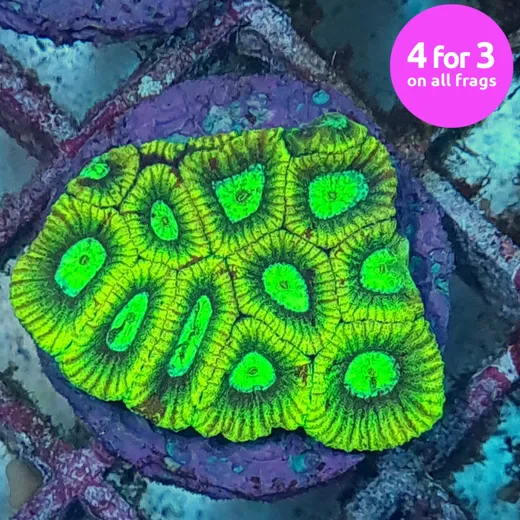
Green Favia LPS Coral Frag #16082
Favia (Favia sp.)
Pink and green coloration
Species: LPS Coral
Intermediate care level required
Approximate footprint: 3cm x 3.5cm
Note: Coral photos are ‘WYSIWYG’ – What You See Is What You Get.
Favia corals can produce stinging tentacles that extend up to several inches beyond their base. Always provide adequate spacing to avoid damaging neighboring corals. As they grow, they develop a skeletal base beneath the fleshy polyps and follow the contours of the rock without strictly encrusting it. Small polyps appear along the edges as the coral expands.
Thrives in moderate water flow and low to moderate light. Ideal for placement in lower sections of a reef tank.
| Parameter | Value |
|---|---|
| Color | Pink, green |
| Size | 3cm x 3.5cm |
| Light Requirement | Low to moderate |
| Flow | Moderate |
| Care Level | Intermediate |
FAQ
Can Favia corals harm other corals?
Yes, Favia corals can sting neighboring corals. Their tentacles can extend several inches beyond their base, so they should be placed with sufficient space from other corals.
What is the ideal lighting and water flow for this coral?
Favia corals thrive in low to moderate light and moderate water flow. Place them in the lower section of the reef tank for optimal conditions.
How does the coral grow over time?
As Favia corals grow, they form a skeletal base beneath the fleshy polyps and follow the shape of the rock. Small polyps appear along the edges as the coral expands.
Michael Clark –
Grew well in my 120-liter reef tank after a few weeks. I placed it in the lower section with moderate flow and it adapted quickly. The green and pink coloration is vibrant and it hasn’t touched any nearby corals yet. Good for beginners who want a stable, low-maintenance LPS coral.
Anthony Abraham –
It’s a solid addition to my tank. I gave it plenty of space and it hasn’t caused any issues with other corals. The growth is steady and the color is natural. I’d recommend it for intermediate reef keepers.
Nicola Davidson –
Perfect for a lower tank zone. It’s easy to maintain and responds well to moderate lighting. The polyps are active and the coral looks healthy after two months. No stinging incidents reported so far.