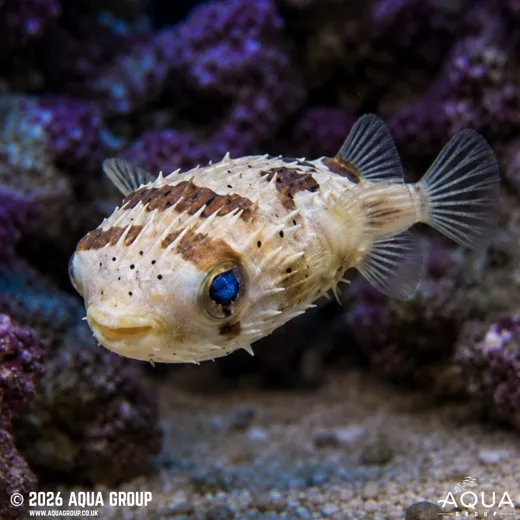
Porcupine Puffer
A large, comically expressive puffer covered in spines that raise when it inflates. Genuinely interactive, and a serious long-term commitment.
Feeding
Carnivorous with hard-shelled prey. Needs shell-on foods – whole prawn, mussel, clam, crab legs and snails – to wear down continuously growing teeth. Two or three feeds a week.
Compatibility
Not reef safe. Will eat all ornamental shrimp, crabs, snails and small fish. Suitable only with large robust tankmates.
Behaviour and personality
Slow, deliberate and remarkably personable, quickly learning to beg at the glass. Should never be deliberately made to inflate.
Specifications
| Size | 35-40 cm |
|---|---|
| Feeding Frequency | 2-3 times per week |
| Food Type | Shell-on prey (prawn, mussel, clam, crab legs, snails) |
| Reef Safe | No |
| Waste Production | Heavy |
FAQ
What kind of food does the Porcupine Puffer require?
The Porcupine Puffer requires shell-on foods such as whole prawn, mussel, clam, crab legs, and snails to wear down its continuously growing teeth.
Is this puffer safe for a reef tank?
No, the Porcupine Puffer is not reef safe. It will eat ornamental shrimp, crabs, snails, and small fish.
How often should I feed my Porcupine Puffer?
Feed twice or three times per week.
Dorothy Parr –
My Porcupine Puffer has become a regular showpiece in the tank. It slowly learns to approach the glass and beg for food. I feed it shell-on prey weekly and it’s very active during feeding times. The spines raise when it inflates, which is both funny and impressive. Requires a strong filtration system, but it’s worth the commitment.
Grace Robertson –
It’s a unique and engaging pet. After a few weeks, it started begging at the glass. I had to adjust my feeding schedule to match its needs. The tank needs good filtration due to heavy waste. Not for beginners, but a great long-term companion.
Anne Burgess –
The puffer is interesting and has a calm demeanor. I feed it every three days with whole prawns and clams. It doesn’t eat small fish or shrimp, which is good. I’ve noticed it grows slowly, and the spines are quite noticeable when inflated. Needs a large tank and strong filtration.