Creeping Jenny (Lysimachia nummularia)
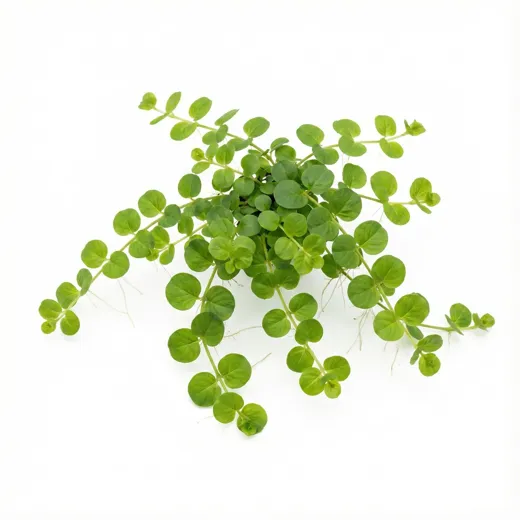
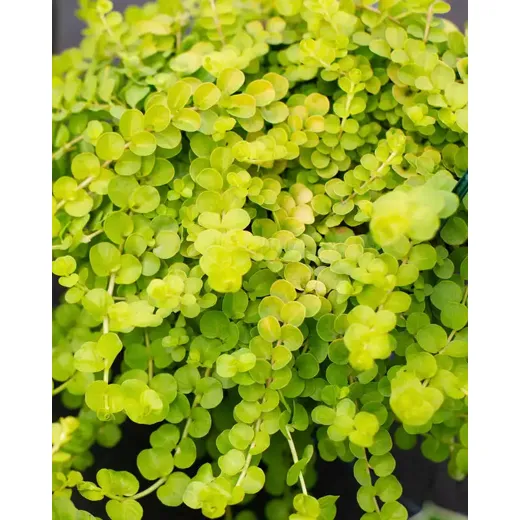
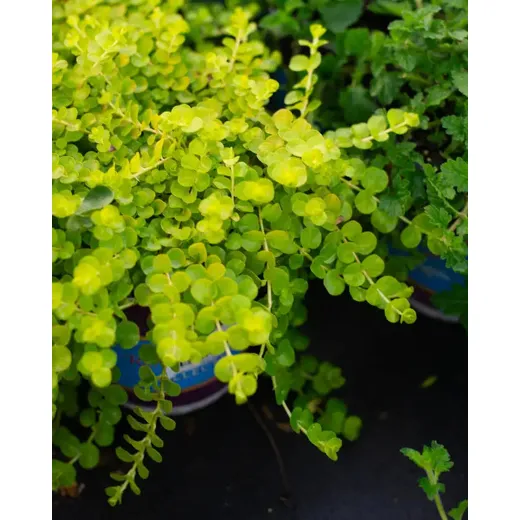
Creeping Jenny is a versatile trailing plant that brings vibrant lime-green to golden-yellow foliage to your aquascape. When grown submerged, it produces long, flexible stems with delicate round to oval leaves, creating a soft, naturalistic texture similar to Hydrocotyle or Bacopa.
Aquatic Growth Characteristics:
- Long, flexible stems that trail horizontally or arch gently upward
- Smaller, thinner leaves than emersed form—round to oval shape
- Lighter green to yellow-green coloration under strong light
- Creeping growth habit, rooting at nodes when in contact with substrate
- Spreads via runners, forming soft mats across the substrate
Care Requirements:
- Lighting: Requires moderate to bright lighting for optimal color and growth
- Substrate: Grows best in fine-grained substrate with good nutrient availability
- Water Conditions: Thrives in soft to moderately hard water with a pH between 6.0 and 7.5
- Water Temperature: Prefers temperatures between 18°C and 26°C
| Feature | Detail |
|---|---|
| Plant Type | Trailing aquatic plant |
| Leaf Shape | Round to oval |
| Leaf Color | Lime-green to yellow-green |
| Growth Habit | Creeping, spreads via runners |
| Rooting | Roots at nodes when touching substrate |
FAQ
What is the ideal lighting condition for Creeping Jenny?
Creeping Jenny requires moderate to bright lighting for optimal color and growth. It performs best under 6 to 8 hours of light per day.
Does Creeping Jenny need special substrate?
It grows best in fine-grained substrate with good nutrient availability. A nutrient-rich substrate supports healthy root development and leaf color.
How does Creeping Jenny spread in the aquarium?
It spreads via runners that trail across the substrate and root at nodes when in contact with the substrate, forming soft, mat-like coverage over time.
Isaac Davidson –
I’ve been growing Creeping Jenny in my 50-liter tank for three months. The plant spreads nicely and adds a soft, natural look. The leaves turn a nice yellow-green under my LED lights. It’s easy to maintain and doesn’t compete with other plants for space.
Phil Knox –
The plant grows slowly at first, but after a few weeks it starts forming a dense mat. I like the color variation—especially in bright lighting. It works well with my floating plants and doesn’t require much pruning.
Thomas Wallace –
Great for beginners. The stems are flexible and don’t break easily. I planted it in a corner of my tank and it spread naturally without needing to trim. The color is vibrant and adds a lot of visual interest.