Common Name
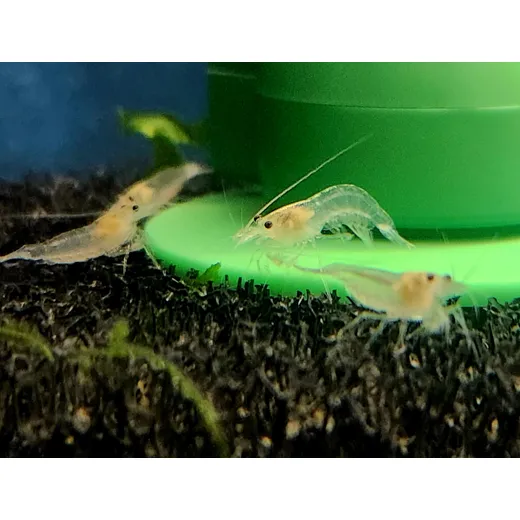
Snow White Amano Shrimp
Origin and Habitat
Caridina multidentata is native to Japan, Taiwan, and nearby island chains. Adults live in cool, clear mountain and foothill streams with rocky beds, submerged roots and wood, and strong biofilm growth on every surface. The species is amphidromous, adults mate in freshwater, larvae drift downstream to brackish estuaries, then post larvae migrate back upstream. The Snow White morph is a selectively bred aquarium line that shows a pale white to milk glass body with translucent highlights, behavior and care match the standard Amano.
Temperature and Water Conditions
Preferred temperature is 68 to 76 F, which is 20 to 24 C, short periods to 78 F, which is 26 C, are possible if oxygen stays high.
| Parameter | Range |
|---|---|
| Water Temperature | 68–76°F (20–24°C) |
| Water pH | 6.5–7.5 |
| Water Hardness | 3–8 dGH |
| Water Flow | Moderate to low |
FAQ
What is the ideal water temperature for Snow White Amano Shrimp?
The ideal water temperature is between 68 and 76°F (20 to 24°C). Short periods up to 78°F (26°C) can be tolerated if oxygen levels remain high.
Do Snow White Amano Shrimp require specific substrate or decorations?
Yes, they thrive in environments with rocky beds, submerged roots, and wood to support biofilm growth. A well-structured habitat with surfaces for biofilm development is recommended.
Are Snow White Amano Shrimp compatible with other aquarium inhabitants?
They are generally peaceful and compatible with most community fish and invertebrates, especially those that do not disturb the substrate or biofilm.


Leah Scott –
The Snow White Amano Shrimp are beautiful with their translucent white bodies. They are active and clean the tank by eating algae and detritus. I’ve kept them for over six months and they’ve adapted well to my 10-gallon tank with moderate flow and stable temperature.
Kylie Hamilton –
These shrimp are a great addition to my freshwater setup. They stay active and help maintain cleanliness. I noticed they prefer areas with rocks and wood where biofilm grows. The color is very subtle and elegant, especially under soft lighting.
Victor Ross –
I was impressed by how quickly they established themselves in the tank. They don’t seem to stress easily and are very hardy. I keep them with small tetras and they coexist peacefully. The water parameters are stable and I maintain a consistent temperature.