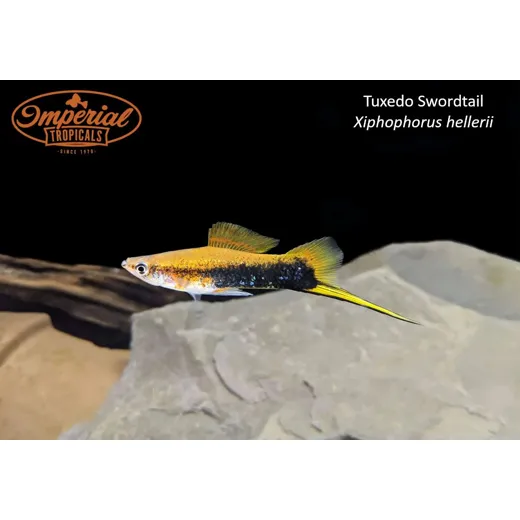
Tuxedo Swordtail Fish
A perfect starter fish! Swordtails are peaceful community fish that reproduce with ease. They are livebearers, meaning the females release live fry rather than laying eggs. It is recommended to keep more females than males, as males can easily harass females with relentless attempts to reproduce, leading to stress in the females. Dominant males will begin developing swords and a modified anal fin, called a gonopodium, around 1-1.5″ in length. However, it is not uncommon for less dominant males to maintain the physical appearance of a female until much later in life (even as large as 4″!).
This strain of swordtail has a half black body dotted with blue iridescent scales. The rest of its body is typically orange in color, but there is some variation.
| Species | Swordtail (Xiphophorus maculatus) |
|---|---|
| Sex Ratio Recommendation | More females than males |
| Reproduction Type | Livebearer |
| Male Development | Develops sword and gonopodium at 1-1.5″ length; some males retain female appearance longer |
FAQ
How many males should I keep with females?
It is recommended to keep more females than males to reduce stress on females and prevent harassment from dominant males.
Do swordtails lay eggs or give birth to live young?
Swordtails are livebearers, meaning females release live fry rather than laying eggs.
Can male swordtails look like females?
Yes, less dominant males may retain a female appearance for a long time, even reaching sizes up to 4 inches.

Michelle May –
Easy to care for and very peaceful in a community tank. The tuxedo coloration is striking and the fish are active without being aggressive. I kept 5 females and 2 males, and the females stayed calm. The fry appear healthy and active after a few weeks.
Sophie Walker –
Beautiful fish with a unique black and blue pattern. The males developed swords after a few months, but I had one male that stayed female-looking even at 3 inches. Great for beginners looking for a low-maintenance, colorful fish.
Penelope Slater –
Perfect for a small community tank. They don’t fight and coexist well with other peaceful fish. The color variation is subtle but eye-catching. I’ve had them for three months and they’re still thriving.