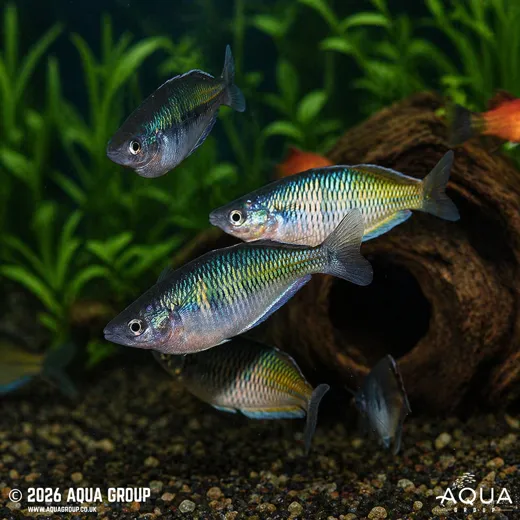
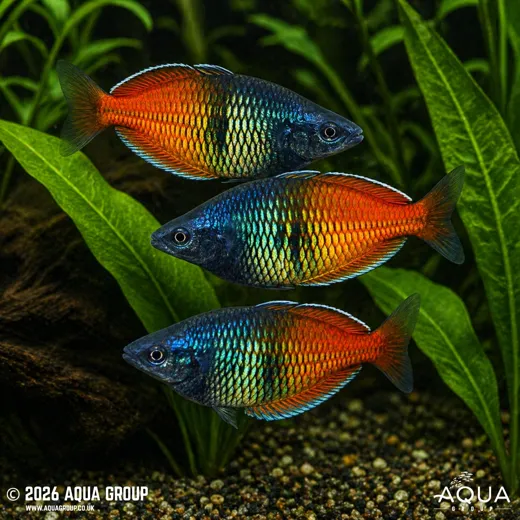
Red Boesemani Rainbowfish
A line selected for a deeper, more extensive red across the rear half of the body. Same fish and same requirements as the standard Boeseman’s, with the colour pushed further.
Feeding
Flake, micro-pellets and frozen daphnia, bloodworm and brine shrimp. Feeds mainly in the upper half of the tank and takes food readily.
Compatibility
Peaceful but fast and active. Keep in groups of six or more with a mix of sexes. Best with other rainbowfish, larger tetras and barbs rather than slow or long-finned species.
Behaviour and Personality
Powerful, constantly moving swimmers. Males display hard to one another and to females, flaring fins and flashing a bright stripe across the forehead.
Specifications
| Species | Red Boesemani Rainbowfish |
|---|---|
| Brand | Real Aquatics |
| Size (adult) | 4-5 inches |
| Temperature | 72-82°F |
| Water pH | 6.0-7.5 |
| Group Size | 6 or more |
FAQ
What is the main difference between Red Boesemani Rainbowfish and standard Boeseman’s?
The main difference is the deeper, more extensive red coloration across the rear half of the body in Red Boesemani Rainbowfish.
How should I feed my Red Boesemani Rainbowfish?
Feed flake, micro-pellets, and frozen foods like daphnia, bloodworm, or brine shrimp. They feed mainly in the upper half of the tank and take food readily.
What kind of tank mates are suitable for Red Boesemani Rainbowfish?
Best kept with other rainbowfish, larger tetras, and barbs. Avoid slow or long-finned species due to their active and fast nature.


Sam Slater –
The red coloration is striking and stands out in the tank. My fish are active and enjoy feeding. I keep them in a group of six with mixed genders, and the interactions are lively but not aggressive. Good for a vibrant, dynamic aquarium.
Alan Martin –
The fish are very active and show clear color changes when displaying. I noticed the red on the back is more intense than standard Boeseman’s. Feeding is easy and they stay in the upper part of the tank.
Amanda Hill –
Great addition to my community tank. The fish swim constantly and the males flash their bright forehead stripe during displays. I’ve kept them with neon tetras and barbs, and they coexist well.