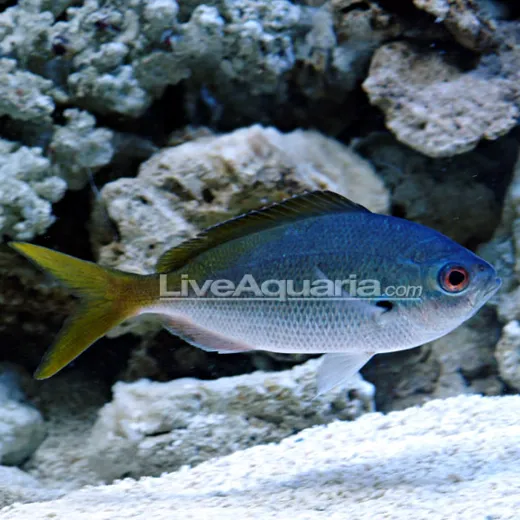
Blue and Yellow Fusiler
The Blue and Yellow Fusiler occurs in very large schools among the reefs of the Western Pacific. Their bodies are long and slender and are silver to blue in color with a striking yellow stripe that covers the back of the fish. They are a wonderful schooling fish for a large aquarium, and will draw more timid fish out into the open.
A 125-gallon or larger aquarium with plenty of swimming room is recommended. A small school of 5 or more Blue and Yellow Fusilers makes an impressive display in a large FOWLR (Fish Only With Live Rock) aquarium. They do well with groupers, snappers, large wrasse, and other large predatory fish as long as they are not large enough to consume the Fusilers. They are not reef safe, as they will consume most invertebrates within the aquarium.
Specifications
| Feature | Detail |
|---|---|
| Species | Blue and Yellow Fusiler |
| Size | Up to 10 inches |
| Water Temperature | 75-82°F |
| Water pH | 8.1-8.4 |
| Compatibility | Large predatory fish; not reef-safe |
| Minimum Tank Size | 125 gallons |
| School Size | 5 or more fish recommended |
FAQ
What is the minimum tank size required for Blue and Yellow Fusilers?
A 125-gallon or larger aquarium is recommended to provide enough swimming room.
Are Blue and Yellow Fusilers safe for a reef aquarium?
No, they are not reef safe as they will consume most invertebrates within the aquarium.
What types of fish can be kept with Blue and Yellow Fusilers?
They do well with groupers, snappers, large wrasse, and other large predatory fish as long as they are not large enough to consume the Fusilers.


Stephanie Davies –
We added a school of five Blue and Yellow Fusilers to our 150-gallon tank. They are very active and create a stunning visual display. The yellow stripe on their backs stands out beautifully. They seem to encourage other fish to swim more freely. Just make sure your tank has plenty of open space and no invertebrates. Overall, a great addition to a large FOWLR setup.
Isaac Watson –
The fusilers are lively and form a strong school. We noticed they are not compatible with any soft corals or clams. We removed those invertebrates before introducing them. They thrive in a spacious tank with other larger fish. A bit of caution needed with tank mates.
William Hill –
After a few weeks, the school became a focal point in our aquarium. The color contrast is impressive. We keep them with large wrasse and a group of snappers. No issues so far. Just ensure the tank is large enough and avoid small or aggressive fish.