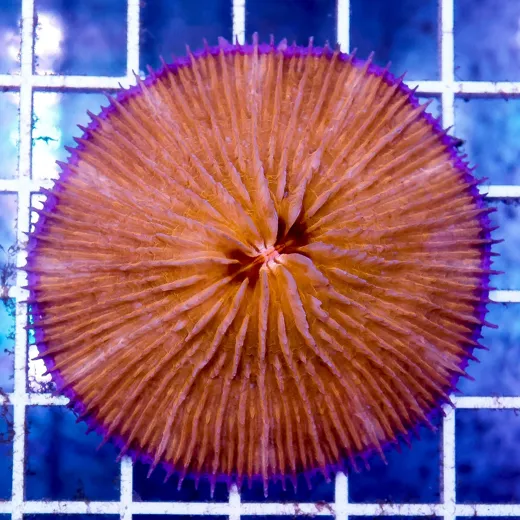
Orange Short Tentacle Plate Coral
The Orange Short Tentacle Plate Coral is a relatively hard to find coral that originates from the Indo Pacific. These corals are found free living within the rubble zones of the reef, and have the ability to inflate themselves to both maximize light exposure, and to keep from being covered in sand.
It is a solitary, semi-aggressive coral with shorter tentacles than its cousin the Long Tentacle Plate Coral (Fungia sp.). Even with short tentacles, it can still damage other corals that it comes in contact with. With placement in the aquarium, keep in mind that it will often inflate itself with water and expand to twice its size. It will do best on the bottom of a reef aquarium, preferably lying on a fine sandy substrate. The Orange Short Tentacle Plate Coral is easy to maintain.
| Specifications |
|---|
| Color: Orange |
| Tentacle Length: Short |
| Size: 2.25″ (width) |
| Origin: Indo Pacific |
| Grow Type: Solitary |
FAQ
Can this coral grow to twice its original size?
Yes, the coral will often inflate itself with water and expand to twice its size.
Is it safe to keep with other corals?
No, it is semi-aggressive and can damage other corals it comes into contact with.
What is the ideal placement for this coral?
It should be placed on the bottom of a reef aquarium, preferably on a fine sandy substrate.
Nicola Peake –
I bought this coral for my reef tank and it has been thriving. It inflates nicely when the water conditions are stable and looks vibrant in the lighting. I placed it on the sand bed and it hasn’t touched any other corals yet, though I keep an eye on it. Easy to spot and maintain.
Jasmine Welch –
The coral arrived healthy and matches the description. It’s a bit aggressive, so I kept it in a corner away from other corals. After a few weeks, it expanded as expected and looks great under the LED lights.
Deirdre Hart –
It’s a nice addition to the tank, but I noticed it occasionally bumps into nearby corals. I’ve moved it slightly to reduce contact. Still, it’s colorful and active in the sand zone.