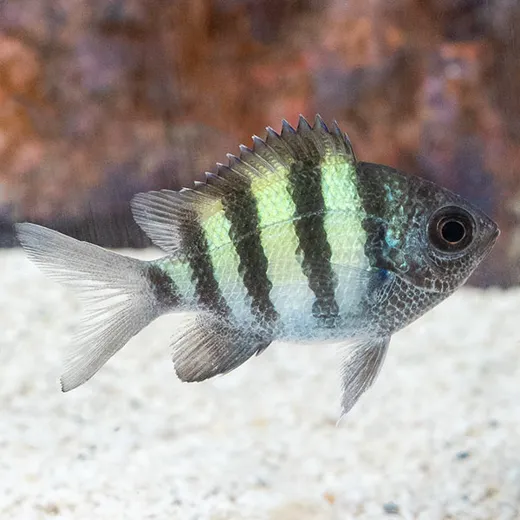
Sergeant Major Damselfish
Hailing from the Indo-Pacific, the Sergeant Major Damselfish (Abudefduf vaigiensis) is a beautiful and unique damselfish that will command attention in your aquarium.
The Sergeant Major Damselfish features a forked caudal fin, oval body, yellow dorsal region, blue and silver belly, and distinct bluish/black stripes running from behind the head down to the caudal fin. This hardy fish has an Easy care-level, making them a good beginner fish for budding marine hobbyists.
The Sergeant Major Damselfish require a larger aquarium than smaller damsels, with a minimum of 75 gallons. They are reef safe and will do well by themselves, as a pair, or in groups of 5 or more. It is recommended to keep Sergeant Major Damselfish in an aquarium with plenty of room and abundant hiding spots.
| Key Features | Details |
|---|---|
| Origin | Indo-Pacific |
| Size | Up to 4 inches |
| Water Temperature | 75–82°F |
| Water pH | 8.1–8.4 |
| Compatibility | Reef-safe; best in groups of 5+ |
| Minimum Tank Size | 75 gallons |
FAQ
What is the ideal tank size for keeping Sergeant Major Damselfish?
A minimum of 75 gallons is recommended to provide adequate space for these fish to swim and establish territories.
Are Sergeant Major Damselfish safe to keep with corals?
Yes, they are reef-safe and generally do not harm corals when kept in a properly maintained aquarium.
How many Sergeant Major Damselfish should I keep?
It is best to keep them in groups of 5 or more for social behavior and reduced stress.



Rachel Smith –
The Sergeant Major Damselfish is a striking addition to my 100-gallon reef tank. Their bright colors and active behavior make them a highlight. I kept them in a group of six and they seem very comfortable. The fish are easy to care for and don’t show signs of aggression toward other species.
Jake Pullman –
I was initially worried about compatibility with my corals, but the fish are peaceful and haven’t damaged any of them. They thrive in a larger tank with plenty of rock structures for hiding. The blue and yellow markings are very noticeable and add a lot of visual interest.
Maria Baker –
After a few months, the fish have become quite active and show natural schooling behavior. I kept them in a group of five and they stay together most of the time. The tank has plenty of space, and they seem happy and healthy.