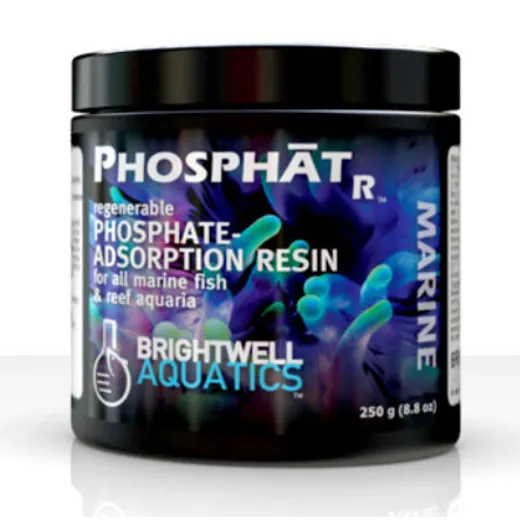
PhosphatR 250ml – Advanced Phosphate and Silicate Removal Resin
Next-generation regenerable phosphate adsorption resin designed specifically for marine aquaria. Effectively removes both phosphate and silicates from water.
- Outperforms activated alumina and granular ferric media in efficiency.
- Does not degrade or disintegrate during use, maintaining stable water quality.
- Does not release phosphate or silicate when exhausted and contains no aluminum that could dissolve and harm aquatic life.
- Constructed from durable synthetic polymer beads, offering excellent flow characteristics and compatibility with various filtration systems including fluidized-bed, canister, or passive filtration setups.
- Can be regenerated up to five times, significantly improving long-term cost efficiency.
| Specification | Detail |
|---|---|
| Volume | 250ml |
| Application | Marine aquariums |
| Removes | Phosphate, Silicates |
| Regeneration Cycle | Up to 5 times |
| Material | Synthetic polymer beads |
FAQ
Can PhosphatR be used in both marine and freshwater aquariums?
PhosphatR is specifically formulated for marine aquaria and may not be suitable for freshwater systems.
How often should the resin be regenerated?
The resin can be regenerated up to five times before replacement is needed.
Will the resin release harmful substances into the water after use?
No, once exhausted, it does not release phosphate or silicate and contains no aluminum that could dissolve and harm aquatic life.

Amanda Metcalfe –
I’ve used PhosphatR in my 120-gallon marine tank for three months. Phosphate levels dropped significantly, and my corals are thriving. No issues with water clarity or fish behavior. The resin stays intact and doesn’t break down like other media I tried.
Heather Wilson –
After switching from granular ferric, I noticed less algae growth. The resin works well in my canister filter and is easy to regenerate. No aluminum leaching, which was a concern with previous products.
Rebecca Sharp –
Good performance in reducing phosphate. It’s durable and flows smoothly in my system. Regeneration took a bit of effort, but the five-cycle limit makes it cost-effective over time.
Deirdre Fraser –
The only downside is the small volume—250ml is enough for a small tank. For larger setups, consider scaling up. Otherwise, it’s reliable and safe for marine life.