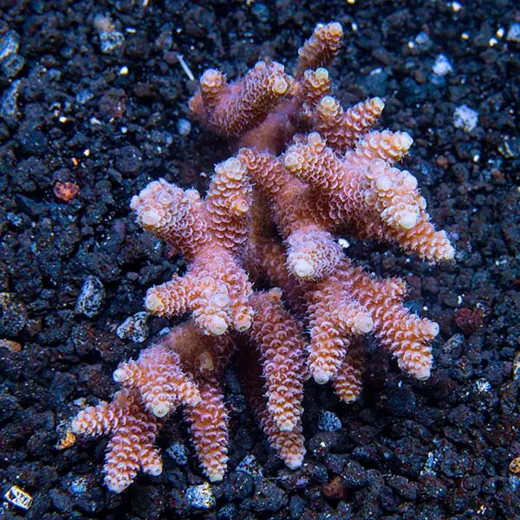
Pink and Blue Millepora Acropora Coral
Aside from Pink and Blue, Millepora Acropora Coral also comes in other pleasing color varieties such as green and pink which will brighten any reef aquarium.Acropora millepora corals are unique in their scaly appearance when the polyps are retracted. These corals can take many different growth forms depending on the water movement and light that it receives, but will typically grow in a clustered form. If provided with enough alternating current, they will show their very long, hairy polyps when feeding.
The maricultured Pink and Blue Millepora Acropora Coral will thrive in a variety of lighting conditions, ranging from power compacts, VHO and T-5, up to the more intense metal halides. Alter their position in the aquarium depending on the lighting, and provide at least 3
| Specifications |
|---|
| Species: Acropora millepora |
| Color: Pink and Blue |
| Growth Form: Clustered |
| Lighting Requirements: Power compact, VHO, T-5, Metal halide |
| Water Movement: Moderate to high |
FAQ
What are the common color variations of this coral?
The coral comes in Pink and Blue, with other color varieties such as green and pink available.
How does the coral grow in an aquarium?
It typically grows in a clustered form, with growth shape influenced by water movement and light exposure. When feeding, it displays long, hairy polyps.
What lighting conditions does this coral require?
It thrives under a range of lighting conditions including power compacts, VHO, T-5, and metal halides.


Alan May –
The coral has added a vibrant touch to my reef tank. It grows well in moderate lighting and shows active polyps when the water flow changes. Very colorful and visually appealing.
Isaac Hudson –
I placed it in a medium-light area and it has adapted well. The pink and blue colors stand out and it seems healthy after a few weeks. Growth is steady and the polyps extend during feeding times.
Donna Allan –
Great addition to my aquarium. The coral maintains its color and structure even with fluctuating light. It’s a reliable and attractive species for reef enthusiasts.