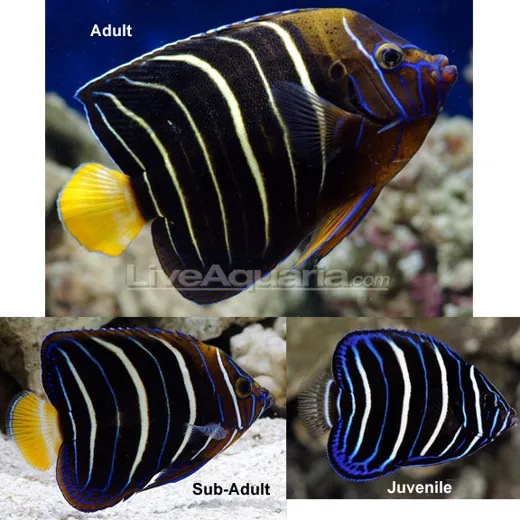
Chrysurus Angelfish
The Chrysurus Angelfish, also referred to as the Goldtail Angelfish or Ear Spot Angelfish, is an uncommon aquarium member because very few are collected for the aquarium industry. It has a body of mottled-brown with vertical white stripes. There are several bright sapphire-blue stripes on the head, and the tail is a dull yellow rimmed in the same sapphire-blue. As a juvenile, the tail is clear in coloration until they reach 3 to 4 inches, at which time it begins to develop the yellow coloration.
The Chrysurus Angelfish requires a 220 gallon or larger aquarium with multiple hiding places and large amounts of live rock for grazing. Not a good reef dweller, the Chrysurus Angelfish is prone to nip at stony and soft corals (sessile invertebrates) and clam mantles, but may be kept with compatible species in a well-established tank.
| Size | 3 to 4 inches (juvenile), grows to 5 inches |
|---|---|
| Water Conditions | Temperature: 76–82°F, pH: 8.1–8.4, Salinity: 1.020–1.025 |
| Compatibility | Best with non-aggressive, large fish; avoid corals and soft invertebrates |
| Feeding | Vegetarian and omnivorous; accepts flake, pellet, and frozen foods |
FAQ
What is the typical size of a Chrysurus Angelfish when mature?
The Chrysurus Angelfish grows to about 5 inches in length when mature.
Is the Chrysurus Angelfish suitable for a reef tank?
No, the Chrysurus Angelfish is not suitable for a reef tank as it may nip at corals and soft invertebrates.
What kind of tank size is recommended for this fish?
A 220-gallon or larger aquarium is recommended to provide adequate space and hiding places.


Justin Churchill –
The Chrysurus Angelfish is a striking addition to a large marine tank. It has beautiful coloration that changes as it matures. I’ve kept it for over a year and it’s very active, though I had to remove a few corals due to nipping. Still, it’s a unique and eye-catching species.
Alison Buckland –
This fish is quite rare and looks stunning in a well-established tank. It’s peaceful when given space and live rock. I noticed the tail color develops slowly, which is a nice feature to watch over time.
Boris Jackson –
The fish arrived healthy and seems to adapt well. However, it does show interest in grazing on live rock, so I’ve had to monitor coral placement. Not ideal for reef setups, but great for large, open tanks.