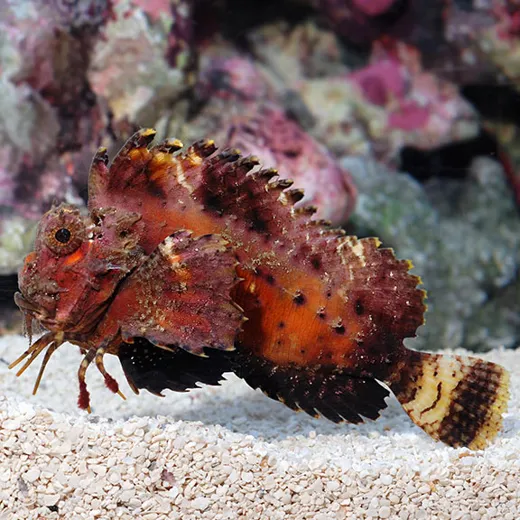
Orangebanded Stingfish
Hobbyists looking for an envy-inducing oddball for the venomous aquarium will find a truly unique specimen in the Orangebanded Stingfish.
Able to bury itself in ambush up to its high-set eyes, what truly sets this well-camouflaged fish apart are its pectoral rays which resemble “claws.” The Orangebanded Stingfish uses these for both prey capture and locomotion across the muddy sea floor.
Provide a 50-gallon or larger aquarium with enough substrate for the Orangebanded Stingfish to bury itself. Since they are carnivorous hunters, only house with other fish that won’t make tempting prey for their large vacuum-like mouths.
Choridactylus multibarbus is known to adapt to prepared foods fairly well. Begin with live ghost shrimp and wean to frozen/thawed.
| Specifications |
|---|
| Species: Choridactylus multibarbus |
| Size: Up to 4 inches |
| Water Temperature: 72-78°F |
| Water pH: 7.8-8.4 |
| Acclimation: Gradual, with live food initially |
FAQ
What kind of tank size is recommended for an Orangebanded Stingfish?
A 50-gallon or larger aquarium is recommended to provide enough space for the fish to bury itself and move comfortably.
Can the Orangebanded Stingfish be kept with other fish?
Only house with fish that are not likely to be seen as prey due to the fish’s large vacuum-like mouth and predatory nature.
What is the diet of the Orangebanded Stingfish?
Start with live ghost shrimp and gradually transition to frozen or thawed foods.
Madeleine Peters –
The Orangebanded Stingfish is a striking addition to my tank. It blends well with the substrate and seems active during feeding times. I started with ghost shrimp and switched to frozen food after a week. It’s not aggressive but definitely keeps the tank interesting.
Claire McLean –
This fish is unique and looks great in the tank. I made sure to use plenty of sand and avoid small, active fish. It hides well and only comes out when hunting. Feeding it live shrimp at first helped it adjust.
Carolyn Russell –
I was skeptical at first, but the fish has become a highlight. It moves slowly and stays buried most of the time. The claws on its pectoral fins are quite noticeable. I now feed it frozen foods regularly and it’s thriving.