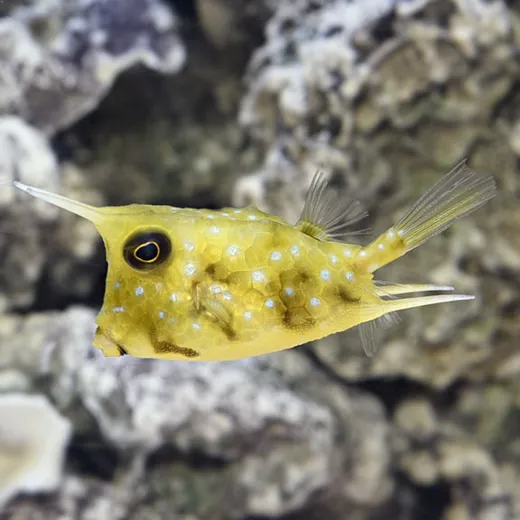
Longhorn Cowfish EXPERT ONLY
The Longhorn Cowfish inhabit the reefs of the Indo-Pacific, usually in the less turbid waters. The body is tan to yellow and covered with white and blue dots, and is occasionally referred to as the Yellow Boxfish; however, the Longhorn is not to be confused with Ostracion cubicus, commonly called the Yellow or Polka Dot Boxfish.
In the wild, it is not uncommon to see a 20″ specimen, while in the aquarium the Longhorn Cowfish tends to be dramatically smaller – 16″ or less.
When possible, the Longhorn Cowfish should be the first fish introduced in the tank. It is intolerant of other Longhorns, so keep it in a large tank, with some live rock for algae scraping. Use caution if placing the Cowfish Longhorn in a reef tank as it may nibble on tubeworms. When housed correctly, the Longhorn Cowfish can thrive in a well-maintained marine environment.
| Specification | Value |
|---|---|
| Origin | Indo-Pacific reefs |
| Coloration | Tan to yellow with white and blue dots |
| Adult Size (in aquarium) | 16″ or less |
| Compatibility | Intolerant of other Longhorn Cowfish; avoid with similar species |
| Reef Tank Suitability | Caution: may nibble on tubeworms |
FAQ
What is the typical size of a Longhorn Cowfish in an aquarium?
The typical size of a Longhorn Cowfish in an aquarium is 16 inches or less, compared to up to 20 inches in the wild.
Can Longhorn Cowfish be kept with other fish species?
Longhorn Cowfish are intolerant of other Longhorn Cowfish and should not be housed with similar species. They can be kept in a large tank with compatible reef fish, but caution is needed due to their potential to nibble on tubeworms.
Is live rock necessary for a Longhorn Cowfish?
Yes, live rock is recommended to provide algae scraping surfaces and to support a stable marine environment.

Stewart Underwood –
I’ve kept a Longhorn Cowfish for over a year now. It’s a striking fish with beautiful white and blue spots. I introduced it first in the tank and it’s been peaceful since. I do have to monitor it closely for any signs of nibbling on tubeworms, but overall it’s a great addition to a well-established reef system.
Anne Pullman –
The fish arrived healthy and looks exactly as described. I kept it in a 120-gallon tank with plenty of live rock. It’s active and curious, but I’ve noticed it spends time near the algae-covered rock. I’m cautious about adding other fish to avoid conflicts.
Ruth Bower –
This is one of the most unique fish I’ve ever had. The coloration is vibrant and it’s very calm. I made sure to introduce it first and keep it in a large tank. It’s not aggressive, and it seems to enjoy the live rock and algae.