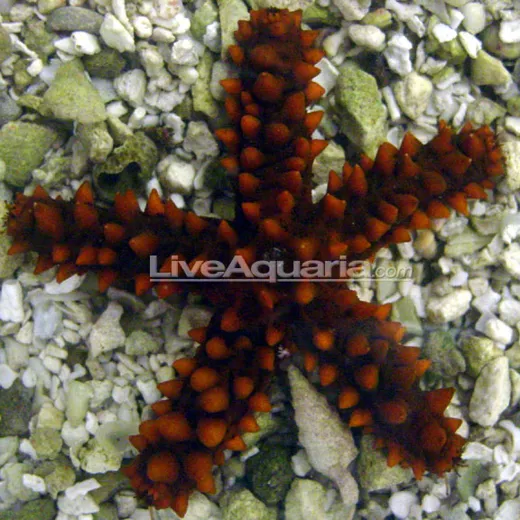
Red Thorny Sea Star
The Red Thorny Sea Star has a thick, gray body with multiple bright red tubercles extending upward along each of its five arms. Red stripes connect these protrusions, giving its back the appearance of wires interconnecting in a grid-like fashion. It is found in shallow tidal pools and up to 100′ deep reefs in the Caribbean Ocean.
Requires a large aquarium with ample supplies of live rock. A small specimen will eat algae. As it grows older, however, it is not reef compatible, as it will eat soft corals, sponges, tubeworms, clams, starfish, and other invertebrates. It should not be housed with puffers.
Very intolerant of sudden changes in oxygen levels, salinity, and pH of the water. Cannot tolerate copper-based medications.
| Key Features |
|---|
| Color: Gray body with bright red tubercles |
| Number of arms: Five |
| Habitat: Shallow tidal pools to 100′ deep reefs in the Caribbean |
| Feeding: Algae (young); soft corals, sponges, clams, invertebrates (adult) |
| Compatibility: Not reef compatible; avoid puffers |
| Water Sensitivity: Intolerant to sudden changes in oxygen, salinity, pH; cannot tolerate copper |
FAQ
What is the ideal tank size for a Red Thorny Sea Star?
A large aquarium with ample live rock is required to provide sufficient space and stable environment.
Does the Red Thorny Sea Star eat other invertebrates?
Yes, as it matures, it will consume soft corals, sponges, tubeworms, clams, starfish, and other invertebrates.
Can the Red Thorny Sea Star be kept with other reef inhabitants?
No, it is not reef compatible and should not be housed with soft corals, sponges, or puffers.
Elizabeth Arnold –
Bought this sea star for my reef tank, but after a few weeks it started eating my soft corals. I realized it’s not reef compatible. Removed it immediately. Would not recommend for reef setups.
Sophie Fraser –
It looks striking in the tank. The red tubercles are very visible. However, it’s not suitable for a mixed community. I kept it alone in a large tank with live rock and it ate algae well at first, but grew too large and began damaging other invertebrates.
Jan Bower –
The appearance is impressive. I placed it in a spacious tank with stable water parameters. It stayed healthy for several months. Just make sure you don’t mix it with other invertebrates or puffers.
Jane Harris –
It’s a beautiful species, but I made the mistake of adding it to a small tank. The water conditions fluctuated and it showed signs of stress. I had to isolate it. Not recommended for beginners.
Robert Knox –
Great visual appeal. I keep it in a large tank with plenty of live rock. It eats algae effectively and doesn’t cause issues as long as it’s the only invertebrate in the tank.