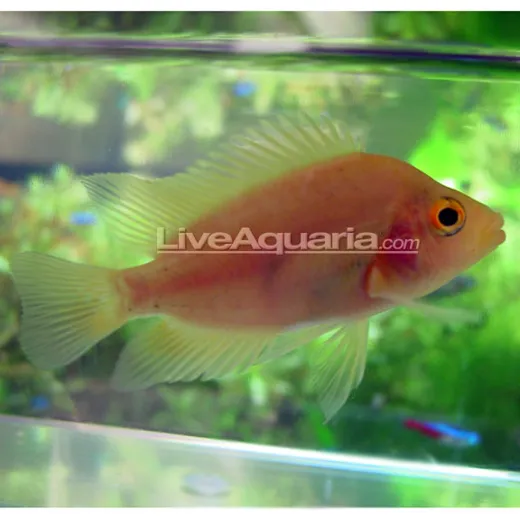
Red Devil Cichlid
The Red Devil is often referred to as the Red Devil Cichlid. The main body color is peach to yellow, with some specimens showing a white underside. The fins are typically white or feature white highlights.
Requires a tank of 50 gallons or more, with ample space for swimming and plenty of stones for hiding. Because it is a digger, rocks should be placed on the bottom of the tank rather than stacked. Stacked rocks may be dislodged and cause damage to the fish.
Known for its aggressive nature, the Red Devil should be housed only with fish that can defend themselves. Spawning occurs on horizontal, slanted, or vertical hard surfaces and does not require a specific substrate.
| Specifications |
|---|
| Species: Red Devil Cichlid |
| Minimum Tank Size: 50 gallons |
| Color: Peach to yellow, with white underside and fin highlights |
| Behavior: Aggressive, digger, requires compatible tank mates |
| Spawning: Open spawner, occurs on hard surfaces |
FAQ
What is the minimum tank size required for a Red Devil?
The minimum tank size required is 50 gallons.
How should rocks be arranged in the tank?
Rocks should be placed on the bottom of the tank and not stacked, as stacked rocks can be knocked over and may harm the fish.
Can Red Devils be kept with other fish?
Red Devils should only be housed with fish that can defend themselves due to their aggressive nature.
Trevor Ince –
The Red Devil is a striking fish with vibrant peach and yellow coloring. I’ve kept it in a 75-gallon tank with a well-structured bottom. It digs around the rocks and is active, but I’ve had to be careful choosing tank mates. It’s not for beginners, but once you get the right setup, it’s a great addition to a community tank.
Gabrielle Clarkson –
I bought this fish for my 60-gallon tank. It’s active and colorful, but I had to remove a few smaller fish that were too timid. The fish digs into the substrate and likes to move around the bottom. I’ve noticed it spawns on a flat rock, which is a nice feature.
Neil Bower –
The Red Devil looks impressive, but it’s very aggressive. I had to keep it alone at first. After adding a few hardy, active fish, it seems to coexist better. The tank needs to be large and well-planned with stable rocks on the bottom.