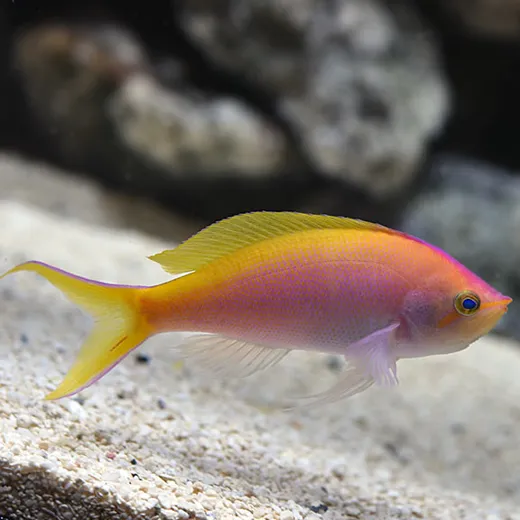
Bartlett’s Anthias – Live Aquaria
The Bartlett’s Anthias is also known as the Bartlett’s Fairy Bass. The males have a more intense coloration with a violet body and yellow running along the back through the upper caudal lobe. The females tend to be lavender in color with a yellow back and caudal fin.
The Bartlett’s Anthias does best when kept with its own kind in a species tank of at least 70 gallons but also makes a beautiful addition to the peaceful fish-only marine aquarium as well as the mixed reef aquarium. The Bartlett’s Anthias will predominantly occupy the middle of the aquarium water column but will venture freely into all regions of the aquarium injecting vibrant color wherever it swims.
To best recreate a natural reef environment for the Bartlett’s Anthias, aquascape with a generous amount of live rock and provide ample hiding places. Good water flow and stable water parameters are essential for their health and well-being.
| Species | Bartlett’s Anthias |
|---|---|
| Gender Coloration | Males: violet body with yellow stripe along back; Females: lavender with yellow back and caudal fin |
| Recommended Tank Size | At least 70 gallons |
| Best Tank Type | Species tank, fish-only marine, or mixed reef aquarium |
| Water Column Behavior | Middle layer, with free movement throughout |
FAQ
What is the difference in coloration between male and female Bartlett’s Anthias?
Males have a more intense violet body with a yellow stripe running along the back through the upper caudal lobe. Females are lavender with a yellow back and caudal fin.
What tank size is recommended for keeping Bartlett’s Anthias?
A species tank of at least 70 gallons is recommended for optimal health and behavior.
Can Bartlett’s Anthias be kept in a mixed reef aquarium?
Yes, the Bartlett’s Anthias can be a beautiful addition to a mixed reef aquarium when properly sized and maintained.



Bella Scott –
The Bartlett’s Anthias adds vibrant color to my 80-gallon tank. The males are striking with their violet bodies and yellow markings. They swim actively in the middle zone and seem very healthy after a few weeks. I keep them with other peaceful fish and they don’t show aggression.
Jane McDonald –
I’ve had these fish for about two months now. The coloration is beautiful, especially the females with their soft lavender tones. They are active and enjoy exploring the rockwork. I recommend keeping them in a species tank or with compatible reef fish.
David Newman –
Great addition to my marine setup. The fish are calm and colorful, and they don’t stress other tank inhabitants. I appreciate the clear description of their coloration and behavior in the product details.