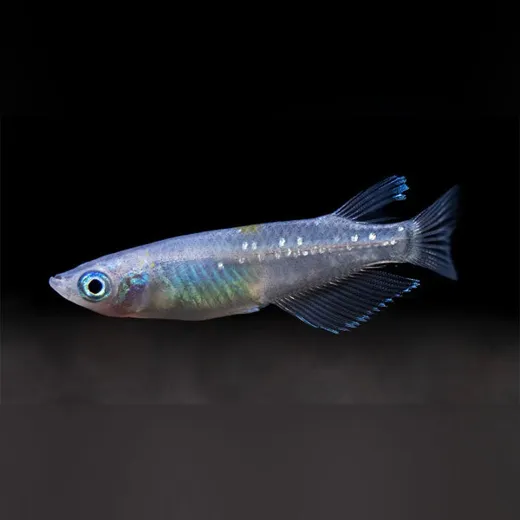
Blue Speckled Ricefish
The blue speckled ricefish is bred in Japan to display subtle blue spots and blue highlights on the fins. Common ricefish are used throughout Asia to control mosquitoes in rice fields, but the variants are quite beautiful and very hardy in the fish tank. Ricefish are similar to killifish but belong to their own genus, Oryzias. Like other ricefish, both sexes are colorful; males have slightly larger fins. Ricefish are sold individually but do best in a school of six or more.
Quick Facts
| Scientific Name | Oryzias latipes (blue speckled variety) |
|---|---|
| Origin | Japan (aquarium-bred) |
| Care Level | Easy, good for beginners |
| Temperament | Peaceful, social |
| Water Temperature | 72–78°F |
| Water pH | 6.0–7.5 |
| Size | Up to 2 inches |
FAQ
What makes the blue speckled ricefish different from regular ricefish?
The blue speckled ricefish has subtle blue spots and blue highlights on its fins, which are not present in standard ricefish varieties. This coloration is achieved through aquarium breeding in Japan.
How many ricefish should I keep in a tank?
Ricefish do best in a school of six or more. Keeping them in groups enhances their natural behavior and promotes better health.
Are ricefish suitable for beginners?
Yes, ricefish are easy to care for and are considered a good choice for beginners due to their hardiness and low maintenance needs.


Carol Smith –
I bought a blue speckled ricefish for my beginner aquarium. It’s very active and the blue spots on its fins are beautiful. I kept it with two others and they swim together peacefully. Easy to care for and stays healthy even with simple water changes.
William Mathis –
The fish arrived quickly and looked healthy. The blue highlights on the fins are subtle but noticeable. I added two more to make a school and they seem to enjoy each other’s company. Water conditions are stable with minimal effort.
Anna Sharp –
This is the first time I’ve kept a ricefish, and I’m very happy with the result. The fish is calm, colorful, and doesn’t stress other tank inhabitants. I keep it in a 10-gallon tank with a heater and it thrives.