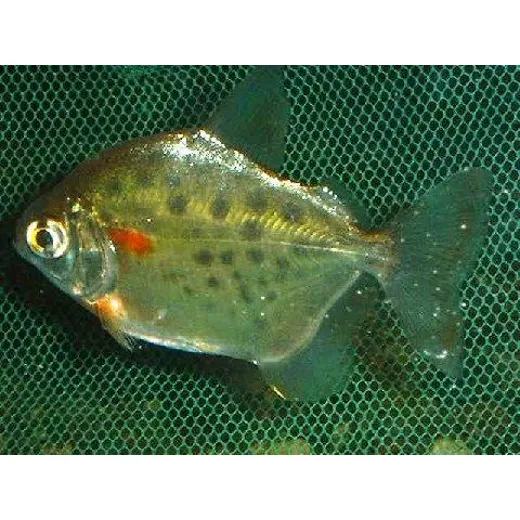
Spotted Silver Dollar
The spotted silver dollar, or green spotted silver dollar, is a larger schooling fish of the streams and rivers of the Brazilian Amazon basin. Though related to the common silver dollar, the spotted silver dollar is a different species. Like silver dollars, spotted silver dollars are one of the hardiest fish in the aquarium trade. Adults have a green hue to the body and black spots. These are peaceful community fish but should not be kept with fish that can fit in their mouths. A school of four makes a nice display. Pictured is an adult silver dollar with full colors.
Quick Facts
| Scientific Name | Metynnis lippincottianus |
|---|---|
| Origin | Amazon basin, Brazil |
| Behavior | Peaceful community fish; best kept in schools of four or more |
| Coloration | Green body with black spots |
FAQ
What is the difference between spotted silver dollar and common silver dollar?
The spotted silver dollar (Metynnis lippincottianus) is a different species from the common silver dollar. It has a green body with black spots, while the common silver dollar is typically silvery with fewer markings. Both are peaceful and hardy, but spotted silver dollars are larger and more active in schools.
How many fish should I keep in a school?
A school of four or more spotted silver dollars is recommended for optimal behavior and visual appeal. Keeping them alone or in small groups may lead to stress or poor color development.
Are spotted silver dollars compatible with other fish?
They are peaceful and suitable for community tanks, but should not be kept with fish that can fit into their mouths, such as cichlids or certain predatory species.


Robert Duncan –
I bought a school of four spotted silver dollars and they’ve been thriving in my 55-gallon tank. They swim together in a nice group and show vibrant green coloration with clear black spots. Very easy to care for and peaceful. No issues with aggression or hiding.
Hannah Cameron –
The fish arrived healthy and looked well-packed. They’ve adapted quickly to the tank setup. I noticed they prefer to swim near the middle and back of the tank. Good for a community tank with tetras and rasboras.
Yvonne Skinner –
After a few weeks, the fish have developed full color. They’re active and social, and the tank looks much more dynamic. I didn’t have to adjust water parameters much, which made it easy to maintain.
Wendy Nash –
They are peaceful and hardy, but I did have to avoid keeping them with any fish that have strong jaws. I’m happy with the color and behavior, though they don’t stay still for long.