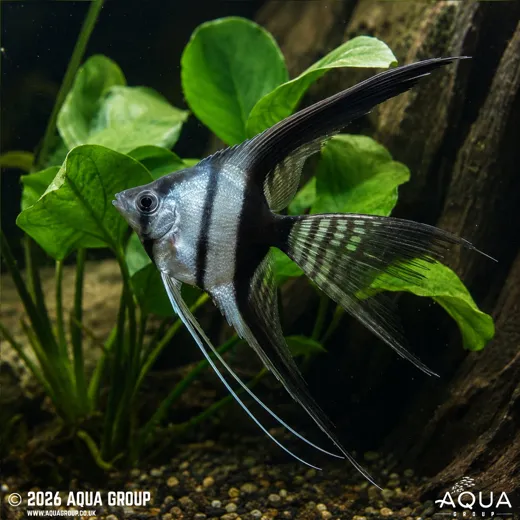
Black and White Veil Tail Angelfish (Pterophyllum scalare)
The Black and White Veil Tail Angelfish, Pterophyllum scalare, is a striking captive-bred form of the freshwater angelfish, bred for dramatic black-and-white patterning and long, flowing veil fins. Its tall body shape, graceful movement and bold contrast make it an impressive centrepiece fish for a mature tropical aquarium. Like all freshwater angelfish, it is generally peaceful for a cichlid, but adults can become territorial when pairing or breeding, and very small tank mates may be eaten.
Common Names
Black and White Veil Tail Angelfish, Black and White Veil Angelfish, Veiltail Angelfish, Freshwater Angelfish.
Scientific Name (Latin)
Pterophyllum scalare
| Specification | Detail |
|---|---|
| Species | Pterophyllum scalare |
| Origin | South America |
| Size (adult) | 3 to 4 inches |
| Water Temperature | 75–82°F |
| Water pH | 6.0–7.5 |
| Water Hardness | 2–8 dGH |
| Compatibility | Peaceful with larger, non-aggressive fish; avoid small or fast-moving species |
| Lifespan | 8–12 years |
FAQ
What is the typical tank size required for a Black and White Veil Tail Angelfish?
A minimum of 30 gallons is recommended to provide adequate space for this fish to swim and establish territory.
Are Black and White Veil Tail Angelfish aggressive toward other fish?
They are generally peaceful but can become territorial when paired or during breeding. Avoid keeping with small or slow-moving species.
Can this angelfish be kept with other angelfish?
It is best to keep only one Veil Tail Angelfish per tank to prevent aggression and territorial behavior.

Jennifer Payne –
The fish arrived healthy and looks beautiful with its striking black and white pattern. It’s a centerpiece in my 55-gallon tank. I’ve kept it for six months and it’s active and calm. Just make sure the tank is large enough and avoid small fish.
Zoe Edmunds –
Great addition to my aquarium. The veil tail movement is very elegant. I noticed it became slightly territorial after a month, so I added a larger fish that doesn’t move quickly. Still, it’s a stunning fish.
James Skinner –
Highly recommended for tropical setups. The color contrast is vivid and the fish is active without being aggressive. I’ve maintained stable water conditions and it thrives.
Elizabeth Knox –
Looks impressive at first, but after a few weeks, it started showing signs of stress with a small tetra. I removed the tetra and now it’s fine. Needs a spacious tank and careful tank mates.