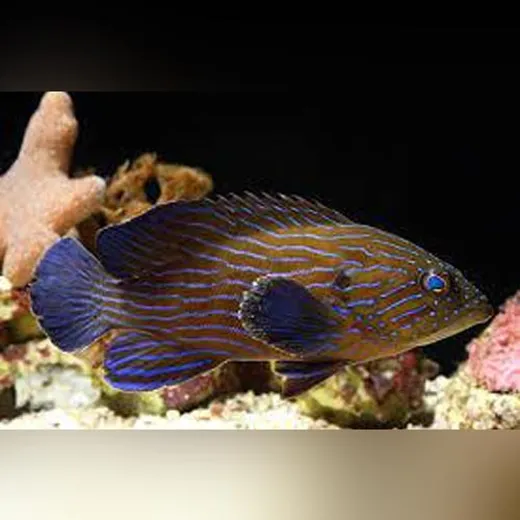
Blue Line Grouper
Blue line groupers are beautiful ambush predators with vivid patterns enabling the groupers to blend with the bright corals. Groupers spend much of their time hiding and watching for easy prey and require large aquariums with good filtration. Caution should be considered when adding this animal to a community tank as it will eat any fish or crustacean that may fit in its mouth.
- Scientific Name: Cephalopholis formosa
- Origin: Indonesia
- Max Size: 12 inches
- Diet: Carnivore
- Shipping Size: 2 to 3 inches
| Feature | Detail |
|---|---|
| Scientific Name | Cephalopholis formosa |
| Origin | Indonesia |
| Max Size | 12 inches |
| Diet | Carnivore |
| Shipping Size | 2 to 3 inches |
FAQ
What is the typical size of a Blue Line Grouper when fully grown?
The maximum size of a Blue Line Grouper is 12 inches.
Is the Blue Line Grouper suitable for a community tank?
No, Blue Line Groupers are ambush predators and will eat any fish or crustacean that fits in its mouth. They are not recommended for community tanks.
What kind of environment does a Blue Line Grouper need?
It requires a large aquarium with strong filtration and should be kept in a setup with plenty of hiding spots, such as coral structures, to mimic its natural habitat.
Trevor Hill –
The Blue Line Grouper arrived healthy and active. It has adapted well to the tank after a few weeks. The coloration is striking and it hides well among the corals. Just make sure your tank is large and has good water flow.
Brian Hart –
It’s a beautiful fish with vivid blue lines. I was cautious about adding it to my tank, and I’m glad I did. It doesn’t attack other fish, but it does eat small crustaceans. I now have a separate feeding area for them.
Victoria Springer –
The fish looks great and stays mostly hidden. I noticed it eats small fish occasionally, so I removed a few small species. It’s a good addition to a large, well-maintained tank.