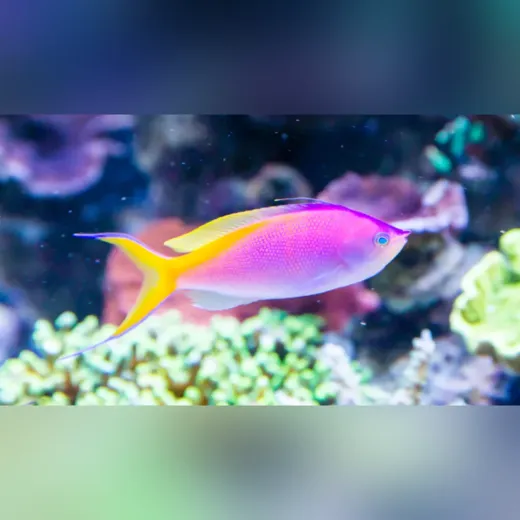
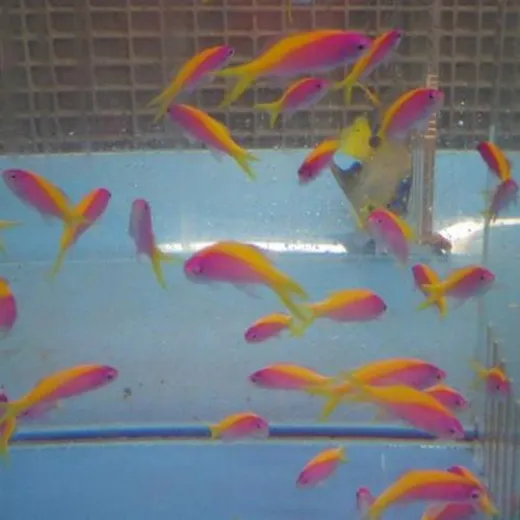
Bartlett’s Anthias (Pseudanthias bartlettorum)
The Bartlett’s Anthias has a sleek body that displays a brilliant shade of purple or pink, with a striking yellow dorsal fin and tail. It is an active, open-water swimmer that thrives in groups, creating a stunning visual display when swimming together.
This species is completely reef-safe and will not harm corals or invertebrates, making it ideal for community tanks. Due to its high metabolism, it requires a well-established aquarium and consistent, small feedings throughout the day.
| Key Features | Details |
|---|---|
| Coloration | Purple or pink body with yellow dorsal fin and tail |
| Behavior | Active, open-water swimmer; prefers group housing |
| Reef Safety | Completely reef-safe |
| Feeding | Requires frequent, small feedings due to high metabolism |
| Water Conditions | Well-established tank required |
FAQ
Is the Bartlett’s Anthias safe to keep with corals and other invertebrates?
Yes, the Bartlett’s Anthias is completely reef-safe and will not harm corals or invertebrates.
How many Bartlett’s Anthias should I keep in my tank?
It is recommended to keep at least 6 individuals in a group to observe their natural swimming behavior and create a visually appealing display.
What type of diet does the Bartlett’s Anthias require?
It requires frequent, small feedings throughout the day due to its high metabolism. High-quality, finely chopped marine foods are recommended.

Frank Wilson –
I added a group of Bartlett’s Anthias to my 120-gallon reef tank. They are incredibly active and create a beautiful, dynamic display. The colors are vibrant and they don’t bother any of my corals. I feed them small portions every few hours and they stay healthy and lively.
Gavin Dyer –
The fish are stunning and very peaceful. I kept them in a group of five and they swim together in a coordinated way. They don’t eat much, so I have to feed them regularly, but they thrive in a well-established tank.
Nathan Mackay –
After a few weeks, the anthias became a highlight of my tank. Their yellow fins stand out beautifully against the purple body. I’m happy they’re reef-safe and haven’t caused any issues with my live rock or polyps.