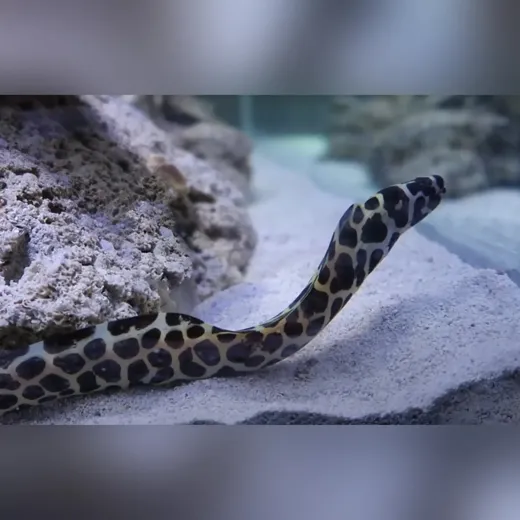
Tessalata Eel: The Giant of the Reef
The Tessalata Eel (Gymnothorax favagineus), also widely known as the Honeycomb Moray or Laced Moray, is one of the largest and most dramatically patterned moray eels available to hobbyists. It is easily identified by its striking, high-contrast coloration: a white or creamy yellow body overlaid with dark brown to black blotches that form a distinct honeycomb or tessellated pattern. This impressive fish is a magnificent, though highly demanding, addition to a very large marine aquarium.
Native to the Indo-Pacific region, from the Red Sea to the Great Barrier Reef, the Tessalata Eel is a true giant, capable of reaching lengths of 5 to 6 feet (150–180 cm).
| Specification | Detail |
|---|---|
| Scientific Name | Gymnothorax favagineus |
| Common Names | Honeycomb Moray, Laced Moray |
| Native Range | Indo-Pacific: Red Sea to Great Barrier Reef |
| Maximum Length | 5 to 6 feet (150–180 cm) |
| Body Pattern | White or creamy yellow with dark brown to black blotches forming a honeycomb pattern |
FAQ
What is the typical size of a Tessalata Eel in captivity?
The Tessalata Eel can grow up to 5 to 6 feet (150–180 cm) in captivity, similar to its wild size.
What kind of environment does the Tessalata Eel require?
It requires a very large marine aquarium with strong water flow, stable temperature, and ample hiding spaces. A spacious tank with rocky structures and crevices is essential.
Is the Tessalata Eel suitable for beginner marine aquarists?
Please contact customer service
Andrea Wilson –
The Tessalata Eel is a stunning addition to a large marine tank. Its unique honeycomb pattern is truly eye-catching. After months of setup, it has settled into the tank and shows no signs of stress. Requires a massive tank and careful maintenance, but the visual impact is worth it.
Melanie Wallace –
We have a 1200-gallon reef tank and finally added the Tessalata Eel. It’s active and curious, and the pattern is breathtaking. We’ve had to adjust water parameters and flow rates, but it’s thriving now.
Joshua Roberts –
The eel is beautiful, but it’s not for small tanks. We had to invest in a large system and ensure proper hiding spots. It’s a high-maintenance species that needs expert care.