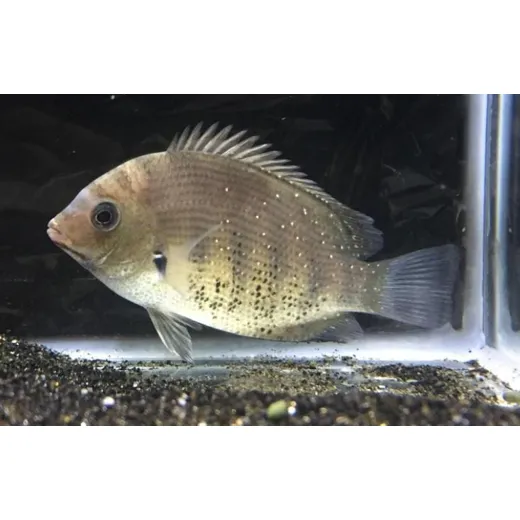
Green Chromide
Scientific Name: Etroplus suratensis
Common Name: Green Chromide
Max Size: 12″
pH: 7.0-8.5
Hardness: Hard
Temperature: 70-82°F
Aggressiveness: Semi-Aggressive
Green Chromides (Etroplus suratensis) are one of the few cichlid species native to Asia. They naturally inhabit brackish estuaries in India and Sri Lanka, where they swim among mangrove roots. These fish are generally peaceful and can coexist in a community tank with robust dither fish such as large Cyprinids (Dawkinsia spp.), livebearers, and Rainbowfish. They adapt well to both freshwater and brackish water conditions.
| Parameter | Value |
|---|---|
| Scientific Name | Etroplus suratensis |
| Common Name | Green Chromide |
| Max Size | 12 inches |
| pH Range | 7.0 – 8.5 |
| Water Hardness | Hard |
| Temperature Range | 70° – 82°F |
| Aggressiveness | Semi-Aggressive |
FAQ
What kind of water conditions do Green Chromides prefer?
Green Chromides thrive in brackish to freshwater conditions with a pH between 7.0 and 8.5, hard water, and a temperature range of 70° to 82°F.
Can Green Chromides be kept with other fish?
Yes, they are generally peaceful and can be kept with robust dither fish such as large Cyprinids, livebearers, and Rainbowfish, especially in a large tank.
Are Green Chromides aggressive during breeding?
They are semi-aggressive and tend to become more territorial during spawning, but otherwise are calm and compatible with many community fish.
Richard Gray –
I’ve kept Green Chromides for six months in a 55-gallon tank with dwarf gouramis and danios. They’re active and peaceful most of the time. The water parameters stayed stable with a pH of 7.8 and temperature around 78°F. They enjoy the brackish setup I provided and don’t stress the other fish.
Alexander Berry –
The fish are beautiful and active. I mixed them with a few Rainbowfish and they get along well. They do become a bit more active during spawning, but that’s expected. The tank needs a bit of space and stable water conditions to thrive.
Harry Hudson –
Great addition to my community tank. They adapt well to the brackish water I maintain. I noticed they swim near the roots and enjoy the structure. Very easy to care for and don’t eat much.