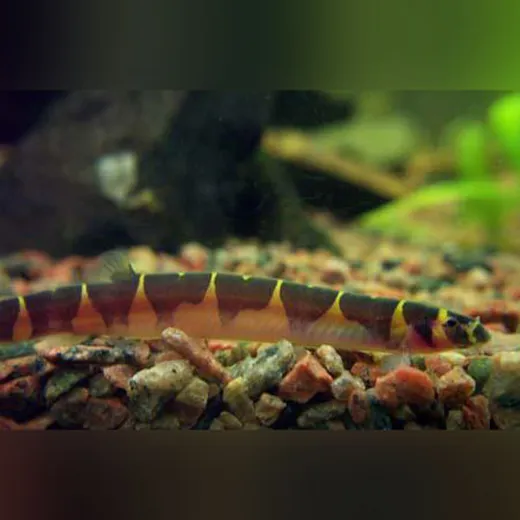
Banded Kuhli Loach
The kuhli loach has an eel- or snake-like appearance with a yellow body and dark brown vertical stripes. Like other loaches, they have barbels around the mouth, which are used to find food in the substrate.
The banded kuhli loach is most active at twilight and at nighttime, both in nature and in the home aquarium, remaining hidden or buried in the sand during the day. Kuhli loaches are happiest when kept in groups of a half dozen or more, and they are easily kept with non-aggressive fish like corydoras, danios, rasboras and tetras.
These are very nocturnal creatures, so often they wait until dark to move throughout the fish tank. We recommend a small school of three to four so at least you have a chance to see a couple of them during the daylight hours.
Quick Facts
| Feature | Detail |
|---|---|
| Body Color | Yellow with dark brown vertical stripes |
| Activity Pattern | Nocturnal |
| Group Size | Best kept in groups of 6 or more |
| Compatible Fish | Corydoras, danios, rasboras, tetras |
| Behavior | Hidden during day, active at night |
FAQ
What is the ideal group size for banded kuhli loaches?
The banded kuhli loach is happiest when kept in groups of a half dozen or more for optimal social behavior and well-being.
Are banded kuhli loaches active during the day?
No, banded kuhli loaches are primarily nocturnal and are most active at twilight and nighttime. They tend to hide in the sand during the day.
What types of fish can be kept with banded kuhli loaches?
They are compatible with non-aggressive fish such as corydoras, danios, rasboras, and tetras.


Adam North –
I kept a group of four banded kuhli loaches in a 10-gallon tank. They were very calm and only moved at night. The dark stripes stand out well against the yellow body. I love how they stay hidden during the day and come out after dark. Great for a low-maintenance, peaceful aquarium.
Neil Parr –
The loaches are quiet and don’t disturb other fish. I added them to a community tank with danios and corydoras. They blend in well and seem to enjoy the sand substrate. I only saw them moving at night, which is expected. A good choice for a nocturnal fish enthusiast.
Tracey Hamilton –
I bought three loaches and they’ve been thriving for over two months. They stay buried in the sand during the day and become active at night. The barbels help them find food easily. I recommend keeping them in a group to see more movement and activity.