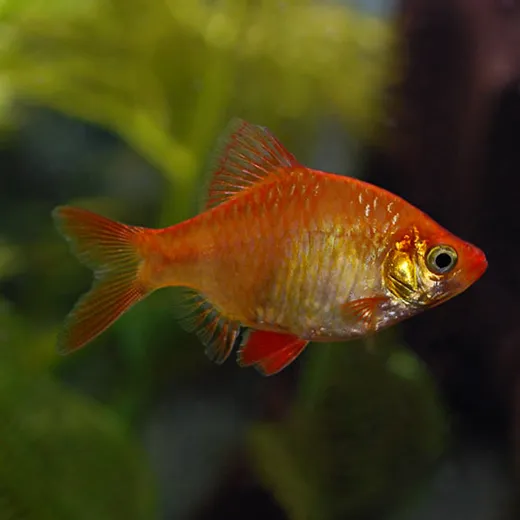
Albino Tiger Barb
The Albino Tiger Barb is cream and gold with white stripes and red/orange accented fins. They are a very lively, playful fish that prefers to be in schools.
They prefer a well-planted tank of at least 30 gallons with soft, slightly acidic water. Rocks and driftwood can be added to the aquarium, but leave plenty of space for swimming. The Albino Tiger Barb is a very active fish that may pester or even nip the fins of larger, slower-moving fish.
Breeding
It is best to house a number of Barbs in the same aquarium until they pair off. After a pair has developed, the female will lay the eggs and the male will follow behind to fertilize. The fry will be free-swimming after about 5 days. Feed the fry newly hatched brine shrimp until large enough to eat other foods.
| Specifications |
|---|
| Color: Cream and gold with white stripes and red/orange accented fins |
| Water Type: Soft, slightly acidic |
| Minimum Tank Size: 30 gallons |
| Behavior: Active, social, may nip fins of slower fish |
| Breeding: Eggs laid by female, fertilized by male; fry free-swimming in 5 days |
FAQ
What is the ideal tank size for Albino Tiger Barbs?
The ideal tank size for Albino Tiger Barbs is at least 30 gallons to provide enough space for their active swimming behavior and to maintain stable water conditions.
Do Albino Tiger Barbs need to be kept in groups?
Yes, Albino Tiger Barbs are social fish and prefer to be kept in schools. Housing them alone or in small numbers may lead to stress or aggressive behavior.
Can Albino Tiger Barbs be kept with other fish?
They should not be kept with larger, slower-moving fish as they may nip or damage their fins. Compatible tankmates should be active and fast-swimming.


Faith Lawrence –
These barbs are very active and add a lot of energy to the tank. I kept them in a 30-gallon tank with plenty of plants and driftwood. They swim constantly and are very colorful. Just make sure not to mix them with slow-moving species.
Sean Carr –
The coloration is striking—creamy with white stripes and bright red fins. They form a nice school and are entertaining to watch. I had to remove a slower fish after a few weeks due to fin nipping.
Penelope Brown –
Great for a community tank with fast-moving fish. The barbs are healthy and active. I’ve observed breeding behavior after a few months, which was exciting to see.