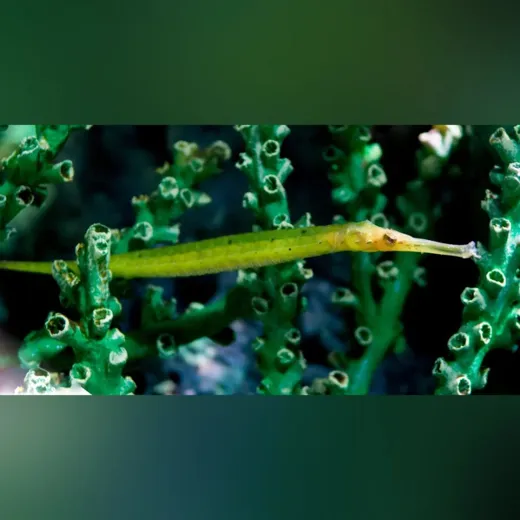
Alligator Pipefish
The Alligator Pipefish (Syngnathoides biaculeatus), also known as the Crocodile Pipefish or Double-ended Pipefish, is one of the largest and most captivating species in the Syngnathidae family (which includes seahorses). Named for its elongated, often green-to-brown body that resembles a small crocodile or alligator, this fish is a slow-moving, stealth predator highly adapted to life in seagrass meadows and floating macroalgae beds.
Native to the tropical and subtropical Indo-Pacific (from East Africa to Australia and Japan), the Alligator Pipefish is technically a “pipehorse” because, unlike true pipefish, its tail is prehensile—it can be used to grasp and anchor itself to vegetation.
| Species | Syngnathoides biaculeatus |
|---|---|
| Common Names | Crocodile Pipefish, Double-ended Pipefish |
| Habitat | Seagrass meadows, floating macroalgae beds |
| Geographic Range | Indo-Pacific region (East Africa to Australia and Japan) |
| Behavior | Slow-moving, stealth predator; uses prehensile tail to anchor to vegetation |
FAQ
What makes the Alligator Pipefish different from other pipefish?
The Alligator Pipefish has a prehensile tail, allowing it to grasp and anchor itself to vegetation, unlike true pipefish which lack this feature. This adaptation helps it remain stable in seagrass and macroalgae environments.
Where is the Alligator Pipefish naturally found?
It is native to the tropical and subtropical Indo-Pacific region, ranging from East Africa through Southeast Asia to Australia and Japan.
Is the Alligator Pipefish suitable for home aquariums?
Please contact customer service

Steven Harris –
The Alligator Pipefish is a striking addition to any marine display. Its unique appearance and gentle movement make it a standout. It thrives in a well-planted tank with seagrass and macroalgae, showing natural behavior like tail anchoring. Easy to observe and very peaceful.
Una Ogden –
I’ve kept this fish for three months now and it’s adapted well to the tank. The prehensile tail is fascinating to watch as it grips the plants. It doesn’t require much space or lighting, just a stable environment with plenty of vegetation.
Gabrielle White –
A beautiful and unique species. The coloration and movement are very natural. It’s not aggressive and blends well with the seagrass. I’m impressed by how it uses its tail to stay anchored—very interesting to watch.