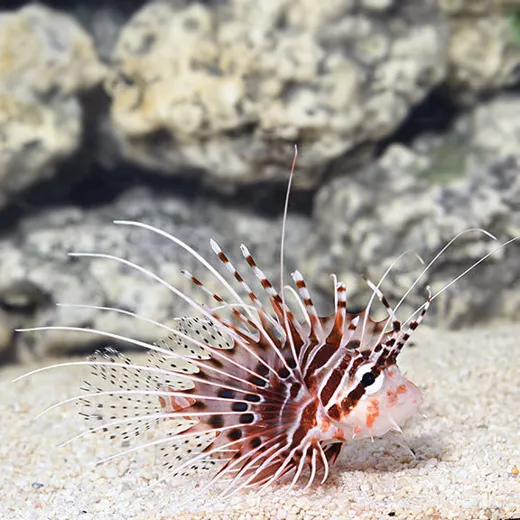
Antennata Lionfish
The Antennata Lionfish, also known as the Ragged-finned Firefish or Spotfin Lionfish, has red, white, and black vertical stripes along the body. Its most striking feature is its large, fan-like pectoral fins and tall, quill-like dorsal fins, lacking connective tissue, giving them a spiny look.
Requires a 50 gallon or larger aquarium with numerous hiding places. The fish will hide during acclimation and should be provided with a good supply of ghost shrimp to encourage feeding.
When first introduced, live saltwater feeder shrimp are recommended to entice the fish to eat. After acclimation, a diet of meaty foods such as live shrimp should be offered.
| Features | Description |
|---|---|
| Body Color | Red, white, and black vertical stripes |
| Fins | Large fan-like pectoral fins; tall, spiny dorsal, pelvic, and anal fins |
| Venomous Spines | Yes — dorsal, pelvic, and anal fins; can cause reactions similar to a bee sting |
| Acclimation | Should be introduced slowly with live shrimp to encourage feeding |
FAQ
What are the key physical features of the Antennata Lionfish?
The Antennata Lionfish has red, white, and black vertical stripes along its body. It features large, fan-like pectoral fins and tall, spiny dorsal, pelvic, and anal fins that lack connective tissue, giving them a sharp, quill-like appearance.
What tank size and environment is required for this fish?
A 50-gallon or larger aquarium with plenty of hiding places is recommended. The fish will hide during acclimation and needs secure shelter to feel safe.
Are the spines on this fish venomous?
Yes, the spines on the dorsal, pelvic, and anal fins are venomous and can cause reactions similar to a bee sting, though stronger. Handle with care.



Isaac Sutherland –
The Antennata Lionfish is a stunning addition to my 75-gallon tank. The color pattern is vibrant and the fan fins are very eye-catching. I provided plenty of caves and hiding spots, and it settled in well after a few days. Feeding started with ghost shrimp, then transitioned to live shrimp. The fish is active but shy, which is normal. I’ve been cautious around the fins and have not had any incidents.
Nicola Pullman –
Beautiful fish with bold markings. I kept it in a 60-gallon tank with plenty of rockwork. It hides during the day and comes out at night. Feeding was initially slow, but after introducing live shrimp, it started eating regularly. The spines are sharp, so I keep my hands away when handling the tank.
Rebecca Newman –
This lionfish is a visual highlight in my reef tank. The red and black stripes stand out well against the background. I followed the feeding advice and started with live shrimp. After a week, it began accepting frozen foods. It’s not aggressive, just curious and active in its own way.