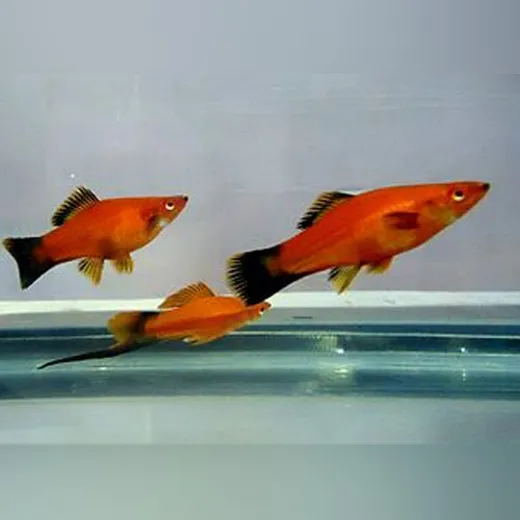
Assorted Swordtails (Lot of 4)
In the wild, swordtails are found throughout Central America. The males have long extensions on the caudal fin that look like swords. This is absent in females, but they tend to grow slightly larger. They are closely related to the livebearing platy and do well in community tanks. Like guppies and platies, they will breed readily in an aquarium. When we make assorted bunches, we try to pack an even number of males and females, though the ratio may vary.
Quick Facts
| Scientific Name | Xiphophorus hellerii (assorted colors) |
|---|---|
| Origin | Southern Mexico to Honduras (wild ancestors); aquarium-bred |
| Care Level | Easy |
FAQ
Are the swordtails in this lot balanced between males and females?
We aim to include an even number of males and females, though the exact ratio may vary slightly.
Do swordtails get along with other fish in the tank?
Yes, swordtails do well in community tanks and are compatible with many peaceful fish species.
How long do swordtails live in an aquarium?
Please contact customer service



Diana Powell –
Received the swordtails in good condition. The colors were vibrant and the fish were active from the start. They seem to be getting along well with my tetras and corydoras. Easy to care for and a nice addition to the tank.
Anthony Springer –
The lot came with a mix of males and females, which is great for breeding. The males have the signature sword tail, and the females are healthy and calm. I’ve noticed they breed regularly, which is a bonus.
Brandon Marshall –
Great variety in colors. The fish are active and swim well. I didn’t expect them to be so easy to maintain. They’ve adapted quickly to the tank environment.