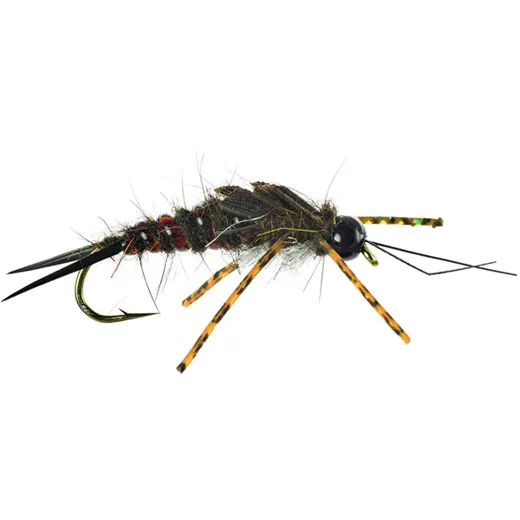
Atomic Stone Nymph – Umpqua
The Atomic Stone Nymph is a specialized pattern designed for fishing in swift, deep waters along the West Coast, particularly the Deschutes River. Developed in the 1990s, this fly was created to address a key limitation of the traditional Kauffman’s Stone—its inability to sink effectively in fast-moving currents.
It features a heavy tungsten bead for initial weight, followed by a lead wrap and lead placement along the sides. This design provides two key benefits: it adds sufficient weight to ensure rapid sinking, and it establishes the natural shape of a stone nymph without excessive bulk.
| Key Features | Details |
|---|---|
| Material | Tungsten bead, lead wrap, lead side placement |
| Design Purpose | Effective sinking in swift, deep water |
| Target Environment | West Coast rivers, especially Deschutes River |
| Origin | Developed in the 1990s by Umpqua |
FAQ
What makes the Atomic Stone Nymph different from the Kauffman’s Stone?
The Atomic Stone Nymph is designed to sink faster and more effectively in swift currents due to its tungsten bead, lead wrap, and lead placement along the sides, which provide better weight distribution and a more streamlined shape compared to the Kauffman’s Stone.
Is the Atomic Stone Nymph suitable for use in deep, fast-moving rivers?
Yes, it was specifically developed for use in swift, deep waters such as the Deschutes River, where sinking performance is critical.
Can the Atomic Stone Nymph be used in still or slow-moving waters?
It is primarily designed for fast-moving, deep-water conditions. In still or slow-moving waters, its sinking performance may not be as effective.
Rose Hudson –
Fished this nymph on the Deschutes during a strong current and it sank immediately. Much better than the Kauffman’s Stone I tried before. The weight distribution makes a noticeable difference in how it moves through the water.
Brandon Fisher –
Used it in a deep run and it stayed on the bottom without floating. The lead placement helps it stay stable and natural-looking in the current. A solid choice for West Coast rivers.
Stephen MacLeod –
This fly performs exactly as described. It sinks fast and holds position in swift water. I’ve used it in several different stretches of the Deschutes and it’s consistently effective.