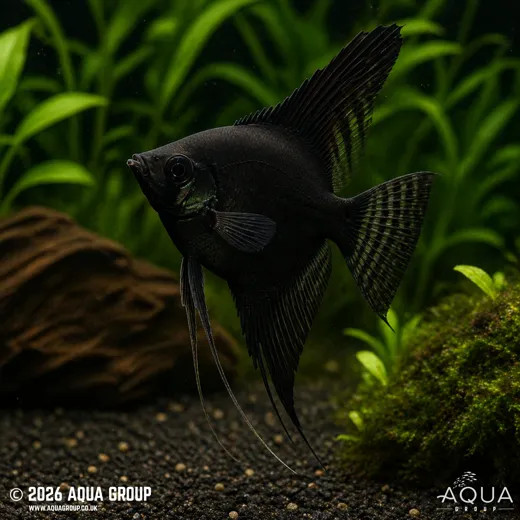
Black Angelfish
An angelfish in near-solid velvet black throughout. Tall, dramatic and a striking contrast against pale planting.
Feeding
Omnivorous. Quality flake and pellets, frozen bloodworm, brine shrimp and mysis.
Compatibility
Peaceful when young and increasingly territorial as adults, particularly once paired. Will eat small fish such as neon tetras and shrimp. Best with medium-sized calm tankmates. Keep as a group of five or more juveniles and let pairs form, or keep a single adult pair.
Behaviour and personality
Slow, deliberate and constantly aware of the tank. Pairs bond strongly and will defend a spawning site against everything else.
Specifications
| Species | Angelfish |
|---|---|
| Color | Near-solid velvet black |
| Feeding Type | Omnivorous |
| Adult Behavior | Territorial, pairs bond strongly |
| Tank Requirement | Tall tank recommended; standard low aquarium not suitable |
FAQ
What kind of tank is recommended for a Black Angelfish?
A tall tank is required for proper accommodation of the finnage. A standard low aquarium will not work.
Are Black Angelfish aggressive toward other fish?
They are peaceful when young but become increasingly territorial as adults, especially when paired. They may eat small fish like neon tetras and shrimp.
How should I feed a Black Angelfish?
Feed a balanced diet of quality flake and pellets, along with frozen foods such as bloodworm, brine shrimp, and mysis.


Heather Walker –
The Black Angelfish is a stunning addition to my tank. Its dark, velvety color stands out beautifully against the pale plants. It’s calm and curious, often watching the surroundings. I kept it with a group of juveniles and it formed a strong pair with another angelfish. The tank needs to be tall, which I had to adjust for, but it’s worth it.
Joseph Gill –
Beautiful fish with a striking appearance. I noticed it becomes more territorial as it matures. I kept it in a tall 55-gallon tank with other calm species. It eats well on flake and frozen foods. A bit shy at first but settles into the tank after a week.
Carolyn Duncan –
The fish is very active and always seems to be observing its environment. I paired it with another juvenile and they bonded quickly. They defend their space well, so I made sure to give them enough room. Great for a planted tank with soft lighting.