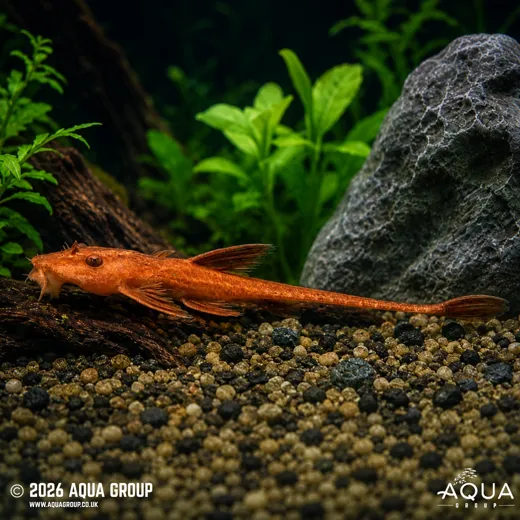
Blood Red Whiptail Catfish
A slender, twig-like loricariid in a deep red captive-bred form, with a long trailing tail filament. Peaceful, unusual and a genuine alternative to the common plecos.
Feeding
Largely herbivorous. Sinking algae wafers, blanched courgette and vegetable-based foods, plus occasional frozen bloodworm. Bogwood should be present.
Compatibility
Entirely peaceful and easily bullied. Keep with calm tankmates only. Fine in groups.
Behaviour and personality
Rests along wood, leaves and flat surfaces during the day, grazing more actively in the evening. Males develop bristles along the snout.
Before you buy
Slow-moving and a poor competitor at feeding time, so it needs food delivered where faster fish will not intercept it. Prefers well-oxygenated water.
| Specification | Detail |
|---|---|
| Species | Blood Red Whiptail Catfish |
| Origin | Captive-bred |
| Size | Up to 6 inches |
| Water Type | Well-oxygenated, neutral to slightly acidic |
| Temperament | Peaceful, non-aggressive |
FAQ
What kind of food does the Blood Red Whiptail Catfish prefer?
It is largely herbivorous and prefers sinking algae wafers, blanched courgette, vegetable-based foods, and occasional frozen bloodworm.
Can it be kept with other fish?
Yes, but only with calm and peaceful tankmates. It is easily bullied and should not be kept with active or aggressive fish.
How does it behave during the day and night?
It rests along wood, leaves, and flat surfaces during the day and becomes more active in the evening, grazing actively then.

Jan Gibson –
The Blood Red Whiptail Catfish is a striking addition to my tank. Its deep red color and long tail make it stand out. It’s very peaceful and spends most of the day resting on the bogwood. I feed it sinking algae wafers and blanched vegetables in the evening. It’s not very active at feeding, so I place food directly where it can reach it without competition.
Sophie Mills –
I bought this catfish to add visual interest and it’s definitely a unique choice. It’s calm and doesn’t bother other fish. I noticed males develop small bristles on the snout after a few weeks. Feeding is a bit tricky because it’s slow-moving, but I’ve learned to place food near the wood where it can access it easily.
Sophie Slater –
This catfish is beautiful and very easy to care for. It’s peaceful and doesn’t stress other fish. I keep it in a 55-gallon tank with other calm species. It grazes in the evening and stays still during the day. The deep red color is vibrant and adds a nice contrast to the tank.