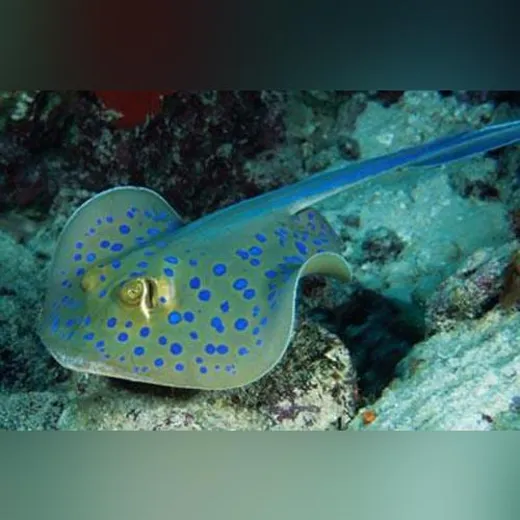
Blue Spotted Stingray
Commonly referred to as the blue-spotted fantail rays, blue spotted stingrays, blue spotted rays, and ribbontail stingray, this species features large bright blue spots on an oval, elongated disc and blue side-stripes along its tail. It makes a visually striking addition to any aquarium.
The Blue Spotted Stingray has a rounded snout and a mouth located on the underside of its body, with gills that help it efficiently scoop up prey hiding in the sand. It is an aggressive feeder, primarily consuming corals, worms, shrimp, hermit crabs, and small bony fish. Because of its feeding habits, it is not suitable for reef tanks.
This bottom-dwelling ray requires a thick layer of sand in the tank. It naturally covers itself with soft substrates for camouflage, making a well-maintained sand bed essential for its comfort and natural behavior.
| Features | Description |
|---|---|
| Body Shape | Oval, elongated disc |
| Color Pattern | Large bright blue spots, blue side-stripes on tail |
| Habitat | Bottom-dwelling, requires thick sand bed |
| Feeding Behavior | Aggressive; feeds on corals, worms, shrimp, hermit crabs, small fish |
| Compatibility | Not suitable for reef tanks |
FAQ
Is the Blue Spotted Stingray safe to keep with other fish in a community tank?
No, the Blue Spotted Stingray is aggressive and not suitable for community tanks. It may attack smaller or slower-moving fish and is not recommended for mixed species setups.
What kind of substrate does the Blue Spotted Stingray need?
A thick layer of soft sand is required to allow the stingray to burrow and hide, which supports its natural behavior and provides camouflage.
Can the Blue Spotted Stingray live in a reef tank?
Please contact customer service




Peter Tucker –
The blue spots are very noticeable and add a unique look to the tank. I provided a deep sand bed and it enjoys digging and hiding. It’s active at night and feeds on small invertebrates I’ve placed in the sand. Not for a reef setup, but great in a large, planted tank with plenty of space.
Jacob Young –
This ray is a real eye-catcher. It spends most of its time buried in the sand, only emerging to feed. The blue markings stand out well. I’ve had it for three months and it’s grown steadily. Just make sure the tank is large and has no coral or small fish.
Sonia Mitchell –
It’s visually striking, but it’s aggressive and scared off a few of my smaller fish. I removed them immediately. The sand bed is essential—without it, it doesn’t feel secure. I’d recommend it only for experienced aquarists with a large, stable tank.