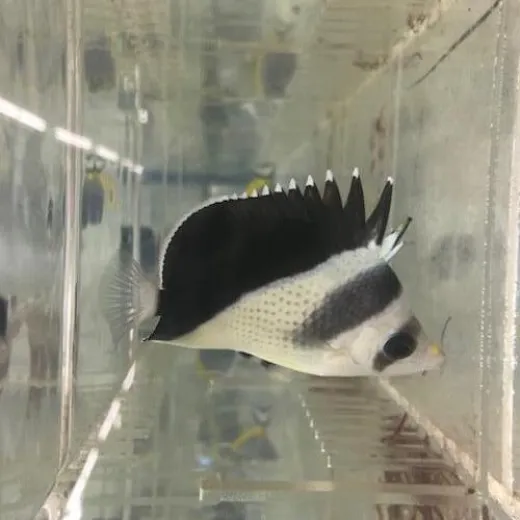
Burgess’ Butterflyfish
Burgess’ Butterfly-fish is a true beauty in the industry. It originates from the deep waters of the reefs in the Western Pacific. Remaining relatively small, the Burgess’ Butterflyfish is predominately black and white in color. There are three black bands that mark these fish. The first black band forms a mask covering the eyes of the fish. The last black band covers a majority of the back of the fish, giving it a unique look. They are relatively hardy fish that will add beauty to the marine aquarium.
Burgess’ Butterflyfish diet primarily consists of coral polyps, crustaceans, and algae in the wild. In an aquarium, frozen and freeze-dried diets containing algae are good substitutes and can be supplemented with dried foods.
| Specification | Detail |
|---|---|
| Species | Burgess’ Butterflyfish |
| Origin | Western Pacific reefs |
| Color | Primarily black and white with three black bands |
| Size | Relatively small |
| Hardiness | Relatively hardy |
| Diet | Algae, coral polyps, crustaceans (in wild); frozen and freeze-dried algae in aquarium |
FAQ
What is the typical size of a Burgess’ Butterflyfish?
The Burgess’ Butterflyfish remains relatively small in size.
What colors does the Burgess’ Butterflyfish have?
It is predominantly black and white with three black bands: one forming a mask over the eyes and another covering most of the back.
What should I feed my Burgess’ Butterflyfish in an aquarium?
Frozen and freeze-dried algae-based diets are good substitutes. In the wild, they eat coral polyps, crustaceans, and algae.



Edward Hart –
The Burgess’ Butterflyfish is stunning in the tank. Its black and white markings with three distinct bands make it stand out. It’s easy to care for and stays active even in a medium-sized reef tank. I feed it algae-based pellets and frozen algae daily. It’s a great addition to any marine setup.
Alan Randall –
I’ve had this fish for three months now and it’s very peaceful. The coloration is vibrant and it looks natural in the tank. I supplement its diet with freeze-dried algae, which it eats readily. It doesn’t seem to compete with other fish, which is a plus.
Matt Morrison –
The fish arrived healthy and has adapted well to the tank. The three black bands are clearly visible and it moves gracefully. I feed it a mix of frozen and dried algae, and it’s always active. Very satisfied with the purchase.