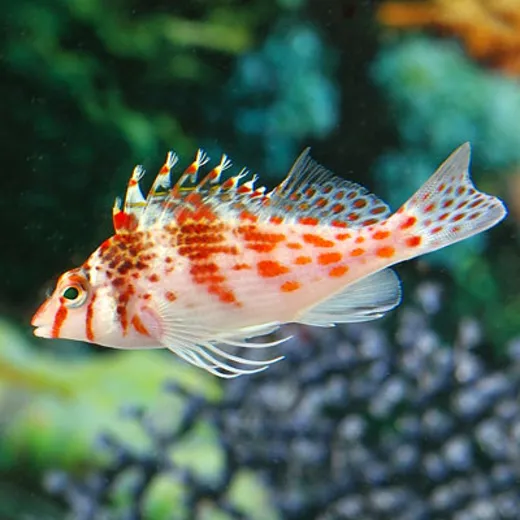
Falco Hawkfish
The dwarf falco hawkfish typically rests at the bottom of massive corals in the reef area. It usually occurs singly but may be in pairs and feeds on fish larvae, small crustaceans and other invertebrates on the seabed. Like many fish, this species can change sex. If a harem becomes too large, one of the females may become a male and take on part of the harem as a dominant male. What makes this species unusual is that the new male may revert to the female sex if challenged by a more powerful male. A male can become a female and successfully breed, laying fertile eggs.
- Scientific Name: Cirrhitichthys falco
- Origin: Indo – Pacific
- Lifespan: 2-4 years
| Characteristic | Detail |
|---|---|
| Feeding Habits | Feeds on fish larvae, small crustaceans, and other invertebrates on the seabed |
| Sex Change Ability | Can change sex; females may become males, and males may revert to females under social pressure |
| Habitat | Reef areas with massive corals, typically at the bottom of the reef |
FAQ
Can the Falco Hawkfish change sex and how does this work?
Yes, the Falco Hawkfish can change sex. If a harem becomes too large, one female may become a male and take on a dominant role. If a stronger male challenges the new male, it may revert back to female. A male can also become a female and successfully breed, laying fertile eggs.
What is the typical lifespan of a Falco Hawkfish?
The typical lifespan of a Falco Hawkfish is between 2 and 4 years.
Where does the Falco Hawkfish naturally live?
The Falco Hawkfish is native to the Indo-Pacific region, typically found in reef areas with massive corals.
Jack Anderson –
The Falco Hawkfish is a fascinating addition to my reef tank. It’s active during the day and stays near the coral structure. I was surprised to learn it can change sex, which adds an interesting dynamic to the tank. It eats small crustaceans and fish larvae, so it helps control the population of tiny organisms.
Thomas Morrison –
This fish is quite calm and doesn’t stress other tank mates. It’s a great species for reef setups with plenty of coral. The sex change behavior is unusual and really interesting to observe over time. I’ve seen one fish transition from female to male and back, which is quite rare.
David Tucker –
I’ve kept this hawkfish for over a year and it’s still healthy and active. It’s not aggressive and prefers to stay in one spot near the reef. The feeding habits are natural and it doesn’t require much attention. The sex change behavior is a unique feature that makes it stand out.