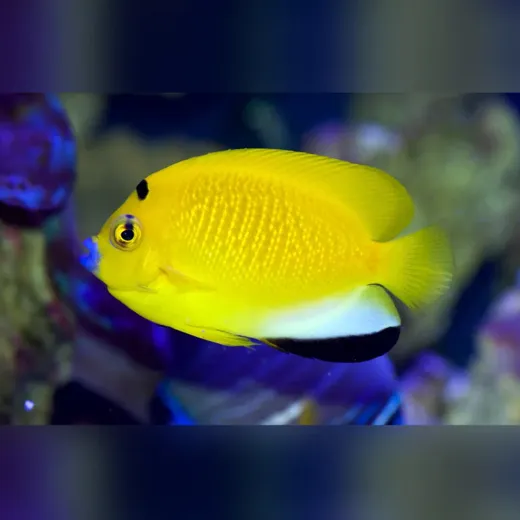
Flagfin Angelfish: The Elegant & Eye-Catching Angelfish
The Flagfin Angelfish (Apolemichthys trimaculatus), also known as the Three Spot Angelfish, is a beautiful and graceful species that adds a touch of sophistication to any marine aquarium. This angelfish is instantly recognizable by its vibrant yellow body and three distinct black spots: one on its forehead, one at the base of its dorsal fin, and a third at the base of its anal fin.
As a large angelfish, it requires a spacious, well-established aquarium with plenty of open swimming space. While generally peaceful with other fish, it can be territorial towards other angelfish. Proper tank setup and compatible tank mates are essential for its well-being.
| Species | Apolemichthys trimaculatus |
|---|---|
| Common Name | Flagfin Angelfish / Three Spot Angelfish |
| Coloration | Vibrant yellow body with three black spots |
| Size | Up to 10 inches (25 cm) in length |
| Temperament | Generally peaceful, can be territorial with other angelfish |
| Water Conditions | Salinity: 1.020–1.025, Temperature: 75–82°F (24–28°C), pH: 8.1–8.4 |
FAQ
What are the key identifying features of the Flagfin Angelfish?
The Flagfin Angelfish is easily recognized by its vibrant yellow body and three distinct black spots: one on the forehead, one at the base of the dorsal fin, and one at the base of the anal fin.
How big does a Flagfin Angelfish grow?
It can grow up to 10 inches (25 cm) in length.
Is the Flagfin Angelfish suitable for a community tank?
It can be peaceful with compatible species, but it may become territorial with other angelfish. A spacious, well-established tank with appropriate tank mates is recommended.


Leonard MacDonald –
The Flagfin Angelfish is stunning in the tank. Its bright yellow body and three black spots make it a centerpiece. I’ve had it for six months and it’s active and healthy. I made sure to keep it in a large tank with plenty of open space and no other angelfish. It’s a beautiful addition to any marine setup.
Lillian Grant –
Beautiful fish with a unique appearance. It’s active and shows interest in the surroundings. I noticed it becomes slightly aggressive when other angelfish are nearby, so I’ve kept it alone. The water parameters are stable and it’s thriving.
Adam Quinn –
I was impressed by how quickly it adapted to the tank. The coloration is vivid and the spots stand out clearly. I’ve maintained good water quality and it’s been very calm since setup. A great choice for a visually appealing marine display.