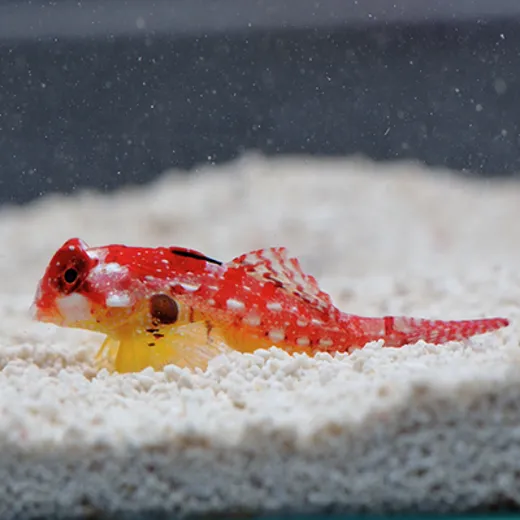
Flame Scooter Blenny (Synchiropus sycorax)
This is a small fish with a large head, top-mounted eyes, and a small pointed mouth. It features a starry pattern of red and white splotches across its body, with bright blue spots on its head.
Native to the Indian Ocean, the Flame Scooter Blenny can be kept either singly or in groups, typically with one male and multiple females.
It accepts prepared fish foods and should be fed a carnivore diet. Supplemental feedings of bloodworms, glassworms, and small inverts are recommended.
It is important to note that the Flame Scooter Blenny is extremely difficult to feed in captivity and requires patience. This species is best suited for expert aquarists only.
| Species | Synchiropus sycorax |
|---|---|
| Origin | Indian Ocean |
| Feeding | Carnivore diet; bloodworms, glassworms, small inverts |
| Compatibility | One male, multiple females; best kept with experienced aquarists |
FAQ
What is the recommended diet for the Flame Scooter Blenny?
The Flame Scooter Blenny should be fed a carnivore diet, including prepared fish foods, bloodworms, glassworms, and small inverts.
Can Flame Scooter Blennies be kept in groups?
Yes, they can be kept in groups, typically with one male and multiple females. They are not recommended for beginners.
Is the Flame Scooter Blenny easy to feed in captivity?
No, it is extremely difficult to get the Flame Scooter Blenny to feed on a captive diet. Patience and expert care are required.

Stephen Jackson –
After months of trying, my Flame Scooter Blenny finally started eating bloodworms. It’s a beautiful fish with striking red and blue patterns. I have one male and two females, and they seem to coexist peacefully. This is a challenging fish, but worth the effort for experienced aquarists.
Melanie Gray –
I’ve kept this fish for over a year. It’s very active and colorful. Feeding is slow and requires daily effort, but once it starts eating, it’s a joy to watch. I recommend only for those who are patient and have experience with live feeds.
Paul Scott –
The fish looks stunning in the tank. I had to try several feeding methods before it accepted food. It’s not a beginner-friendly species. I’m glad I invested time in learning proper care techniques.