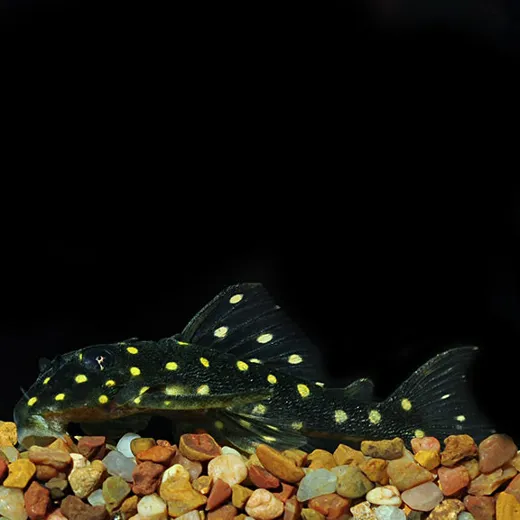
Gold Spotted (L-136) Plecostomus
The Gold Spotted Plecostomus comes from the rivers and tributaries of South America. The main body color is Black with a cream colored belly and small whitish yellow spots covering the body. This dwarf Plecostomus is ideal for any community tank.
Planted tanks with hearty, fast-growing plants, high aeration and water movement make for a healthy environment. Rocks and driftwood help to accent a natural habitat and provide hiding spaces to reduce stress for the Angelicus Pleco. A recommended minimum tank of 30 gallons should be provided to house this fish.
Feeding the Gold Spotted Plecostomus is not difficult due to the fact that it is not a picky eater. Feeding off the bottom of the aquarium, it gets most of its nutrition from left over food and algae. If there is no algae or plant matter available, it can be supplemented with algae wafers or blanched vegetables.
| Specifications |
|---|
| Species: Gold Spotted Plecostomus (L-136) |
| Origin: South America |
| Body Color: Black with cream belly and small whitish yellow spots |
| Size: Dwarf Plecostomus |
| Minimum Tank Size: 30 gallons |
| Water Conditions: Stable, well-aerated, planted tank with driftwood and rocks |
| Feeding: Algae, leftover food, algae wafers, blanched vegetables |
FAQ
What is the typical size of the Gold Spotted Plecostomus?
The Gold Spotted Plecostomus is a dwarf species and typically grows to about 2 to 3 inches in length.
Does this pleco require special water conditions?
It thrives in stable water conditions with a neutral pH, moderate hardness, and good water flow. A well-planted tank with aeration is recommended.
Can it be kept with other fish?
Yes, it is suitable for community tanks and can coexist with non-aggressive fish species.
Maria Campbell –
Easy to care for and very peaceful in the tank. The spots stand out well against the dark background. It’s active during the day and helps clean the tank by eating algae. I’ve had it for six months and it’s still healthy and happy.
Vanessa Gray –
The fish looks beautiful with its black body and yellow spots. It doesn’t seem to compete with other fish and stays near the back of the tank. Feeding is simple—just a few algae wafers each week.
Amanda Wallace –
Great addition to my 30-gallon planted tank. It’s not aggressive and enjoys the driftwood. I noticed it cleaning the glass and substrate regularly. Very satisfied with the purchase.