Common Name
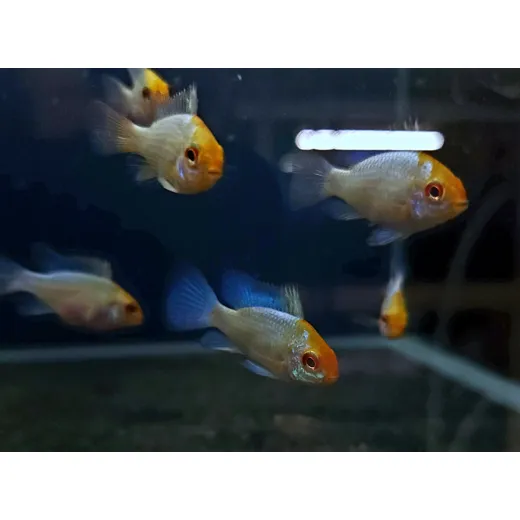
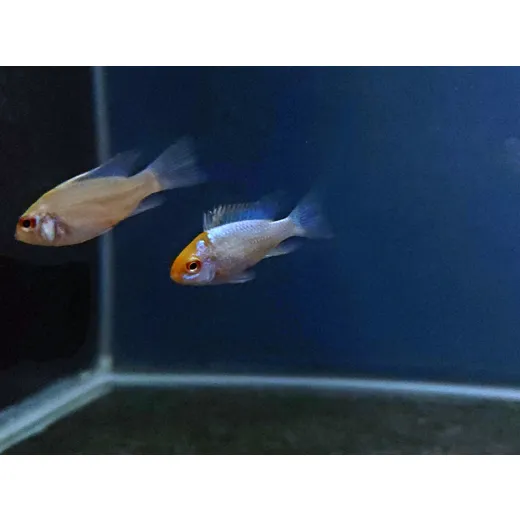
Golden Head Platinum Ram
Origin and Habitat
The species is native to the Orinoco Llanos of Venezuela and Colombia. In the wild it lives in warm, very slow waters such as shallow savannah streams, floodplain pools, and quiet backwaters. These sites have soft sand or silt, leaf litter, tangled roots, and dense marginal plants. Water is often soft and slightly acidic, tea stained from tannins, and gently filtered through vegetation.
Temperature and Water Conditions
Rams are true warm water cichlids. A practical range for long term health is 27 to 30°C, which is 81 to 86°F. Many wild reports place pH slightly acidic, commonly about 5.0 to 6.8, with very low to moderate hardness. We do not recommend chasing or altering water chemistry except for established systems with stable parameters.
Physical Characteristics
| Feature | Detail |
|---|---|
| Body Shape | Slender, elongated with a slightly curved dorsal fin |
| Coloration | Golden head with silver to blue body, bright blue fins |
| Size | Up to 5 cm (2 inches) in length |
FAQ
What is the ideal water temperature for a Golden Head Platinum Ram?
The ideal water temperature range is 27 to 30°C (81 to 86°F).
What kind of water conditions do these fish prefer in the wild?
They prefer soft, slightly acidic water with a pH of 5.0 to 6.8, low to moderate hardness, and water that is tea-stained from tannins due to vegetation.
How big does a Golden Head Platinum Ram grow?
Up to 5 cm (2 inches) in length.
Jacob Hudson –
The fish is vibrant and active. It adapts well to the tank after a week. The coloration is striking, especially the golden head. I keep it in a 20-liter tank with soft water and warm temperature. It seems to enjoy the plants and slow current.
Anna Peake –
Beautiful fish with a unique look. It’s peaceful and doesn’t stress other tank mates. I adjusted the pH to 6.2 and kept it between 28-30°C. It’s active during the day and hides at night.
Ryan Terry –
Arrived healthy and quickly settled into the tank. The blue fins stand out in the dim light. I use driftwood and leaf litter to mimic its natural habitat. Water parameters are stable now.