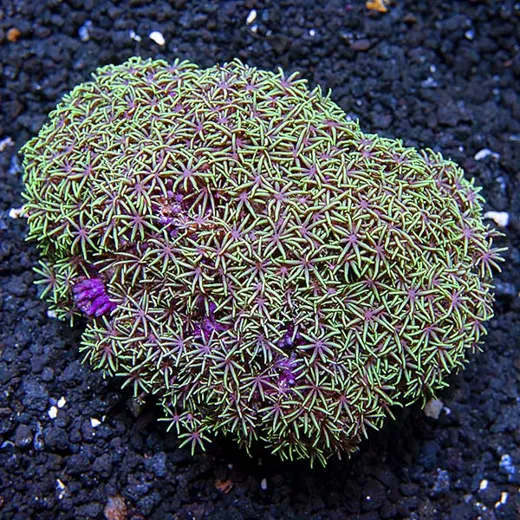
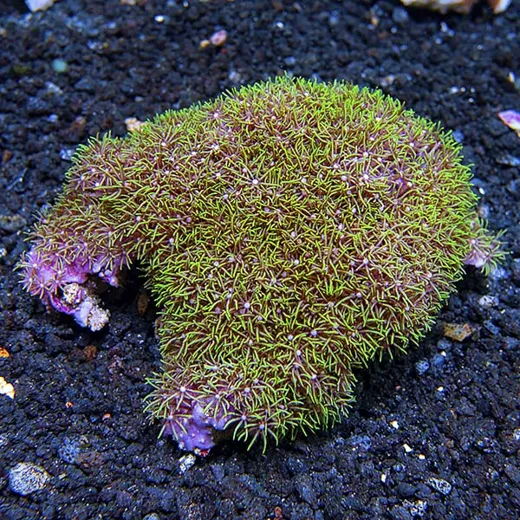
Green Branching Starburst Polyp
Starburst Polyps are also referred to as Star, Eight Tentacle, Mat, or Daisy Polyps. Previously green specimens have been called Clavularia viridis; however, they are now identified as a Briareium sp. Branching Green Starburst Polyps have an extended polyp base with white to light green “eyes”. They have the distinctive eight-leaved tentacles on each polyp. They are colonial animals with several individual polyps attached to a piece of live rock.
Accurately described as an encrusting coral, Starburst Polyps rapidly grow over adjacent rock work, coral, or even the glass of an established reef aquarium. They are a peaceful coral armed with the defensive capability of being able to retract or deflate each of their polyps in response to predation. They will not harm other marine life.
| Specification | Details |
|---|---|
| Species | Briareium sp |
| Polyp Color | White to light green |
| Tentacle Count | Eight per polyp |
| Growth Pattern | Encrusting, colonial |
| Attachment | Live rock, coral, or aquarium glass |
| Behavior | Retracts polyps when threatened |
FAQ
What is the scientific name of the Green Branching Starburst Polyp?
The scientific name is now recognized as Briareium sp, previously known as Clavularia viridis.
How do Starburst Polyps grow in an aquarium?
They grow rapidly by encrusting over live rock, coral, or even aquarium glass, forming a colonial structure with multiple polyps.
Are Starburst Polyps safe for other marine life?
Yes, they are peaceful and do not harm other marine organisms. They can retract their polyps when threatened.

Rebecca Ferguson –
Easy to establish and grows quickly on my live rock. The green polyps with white eyes look beautiful and don’t interfere with other corals. Very peaceful and doesn’t spread aggressively.
Yvonne Wilkins –
Grew well in my 120-gallon reef tank. The eight tentacles are striking and the coloration is vibrant. I noticed they retract when touched, which is a nice defensive trait.
Gordon Springer –
Perfect for beginners. They attach to the rock naturally and spread slowly without overgrowing. Looks great in the display area and doesn’t cause any issues with other species.