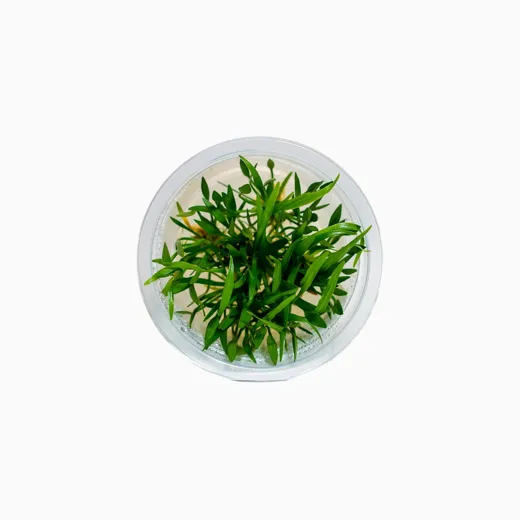
Helanthium tenellum: The Pygmy Chain Sword
Helanthium tenellum, commonly known as the Pygmy Chain Sword or Dwarf Chain Sword, is a versatile and popular grass-like plant/tissue culture used to create a natural, lawn-like foreground carpet in aquariums. It belongs to the Chain Sword group and was historically known by the synonym Echinodorus tenellus until its reclassification. It is prized for its ability to form dense, spreading colonies via horizontal runners, much like a natural turf.
This plant is native to a vast region spanning North, Central, and South America, resulting in variations in leaf size and color. The narrow-leaf variety can develop dark-red or purplish tips under high light and good nutrient conditions, while the ‘Green’ or ‘Broad Leaf’ variety maintains a more uniform, lighter green appearance.
| Characteristics | Details |
|---|---|
| Plant Type | Grass-like, aquatic |
| Growth Habit | Spreading via horizontal runners |
| Light Requirement | Low to medium |
| Water Conditions | Soft to moderately hard water, pH 6.0–7.5 |
| Hardiness | Thrives in tropical aquariums |
FAQ
What are the common varieties of Helanthium tenellum?
The narrow-leaf variety can develop dark-red or purplish tips under high light and good nutrient conditions, while the ‘Green’ or ‘Broad Leaf’ variety maintains a more uniform, lighter green appearance.
How does Helanthium tenellum spread in an aquarium?
It spreads through horizontal runners, forming dense, spreading colonies that resemble a natural turf.
Is Helanthium tenellum suitable for low-light aquariums?
Yes, it thrives under low to medium light conditions and is well-suited for low-light setups.

Stewart Gray –
I’ve been growing Helanthium tenellum for six months and it has filled out my aquarium’s foreground beautifully. The plant spreads evenly and stays healthy even in moderate lighting. The color variation in the leaves is subtle but noticeable, especially in the red tips when the light is strong. Easy to maintain and grows quickly without needing much pruning.
Robert Hemmings –
This plant works well in a community tank. It doesn’t compete aggressively with other species and provides a natural look. I noticed the leaf tips turned slightly purple during summer months when the light was stronger. It’s a great addition to a low-maintenance aquarium.
Austin Peters –
The tissue culture form ensures consistent growth and no root issues. I planted it in a 55-gallon tank with soft water and it has spread well across the bottom. The plant looks more natural than other foreground options and stays lush throughout the year.