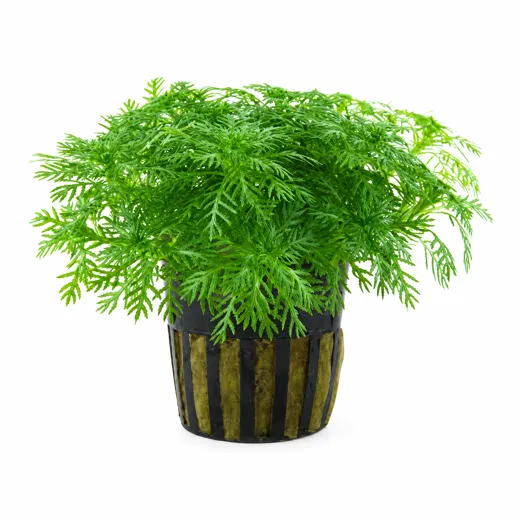
Hottonia palustris
Hottonia palustris is a rare and elegant stem plant native to Europe and western Asia, prized for its finely pinnate, feather-like leaves that create a soft, airy texture unlike almost any other aquatic plant. Submerged, it forms delicate whorls of bright green foliage along each stem, making it an exceptional choice for aquascapers seeking a naturalistic, wild-pond aesthetic in the midground or background of their aquarium.
A true gem for the experienced aquascaper, Hottonia palustris rewards careful husbandry with lush, dense growth and a distinctive visual character that stands out in any planted tank. It performs best with CO₂ supplementation, moderate to high light, and soft, slightly acidic water — conditions that mimic its natural temperate habitat.
| Key Features | Specifications |
|---|---|
| Native Region | Europe and western Asia |
| Growth Type | Stem plant |
| Leaf Structure | Finely pinnate, feather-like |
| Light Requirement | Moderate to high |
| Water Conditions | Soft, slightly acidic |
| CO₂ Requirement | Recommended with supplementation |
FAQ
What is the ideal lighting condition for Hottonia palustris?
Hottonia palustris performs best under moderate to high light conditions.
Does Hottonia palustris require CO₂ supplementation?
CO₂ supplementation is recommended for optimal growth and dense foliage development.
What type of water conditions does Hottonia palustris prefer?
It thrives in soft, slightly acidic water conditions that mimic its natural temperate habitat.

Heather Sanderson –
I’ve been growing Hottonia palustris for three months now and it’s become a standout in my midground. The feather-like leaves add a natural, wild look that’s hard to replicate. I use CO₂ and moderate light, and it’s grown very densely. It’s definitely a plant for experienced aquascapers who want texture and realism.
Molly Payne –
The plant arrived healthy and has been doing well in my 120-liter tank. I noticed it spreads slowly at first but after a few weeks it filled the area nicely. I keep the water soft and slightly acidic, and it’s responded well to the conditions.
Lily Lewis –
After trying several background plants, Hottonia palustris stands out for its delicate, airy appearance. It doesn’t grow fast, but the visual impact is unique. I use CO₂ and high light, and it’s now a focal point in my wild-pond setup.