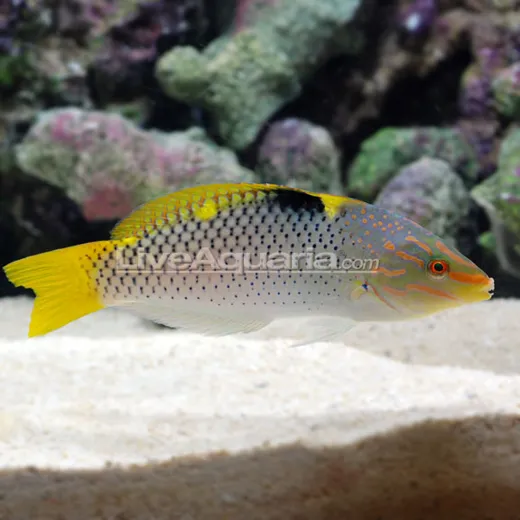
Marble/Hortulanus Wrasse (Juvenile)
The juvenile Marble/Hortulanus Wrasse, also known as the Checkerboard Wrasse, is white with stripes, dots, and patches of black. With maturity, it becomes silver with a distinctive black checkerboard pattern on the body. The dorsal fin and tail are yellow, and the face is light green with orange to pink striped markings.
| Key Features | Coloration: White with black stripes, dots, and patches (juvenile); silver with black checkerboard pattern (adult) Dorsal fin and tail: Yellow Face: Light green with orange to pink striped markings |
|---|---|
| Feeding Habits | Eats fireworms and pyramidellid snails Protects corals and clams May consume feather dusters, wild shrimp, tubeworms, and flatworms Larger specimens may prey on small ornamental shrimp and crabs |
| Recommended Tank Conditions | Minimum 125 gallon tank with sealed lid 2-3 inch sandy bottom for hiding Co-habitation with peaceful wrasses, including its own species |
FAQ
What is the color change of the Marble/Hortulanus Wrasse as it matures?
The juvenile is white with black stripes, dots, and patches. As it matures, it turns silver with a distinct black checkerboard pattern on the body.
What should I feed my Marble/Hortulanus Wrasse?
It primarily eats fireworms and pyramidellid snails. It may also consume feather dusters, wild shrimp, tubeworms, and flatworms. Larger specimens may eat small ornamental shrimp and crabs.
What tank size and setup are recommended for this wrasse?
A 125-gallon or larger tank with a sealed lid is required. Include a 2-3 inch sandy bottom to provide hiding space. Co-habitation with peaceful wrasses, including other Marble Wrasse, is recommended.

Abigail Randall –
The wrasse has been in my 150-gallon tank for three months. It’s very active and has developed its checkerboard pattern nicely. It eats fireworms and snails without disturbing corals. I’ve added a sandy area for it to hide, which helps with its stress levels.
Justin Churchill –
It’s a beautiful fish with a unique appearance. The juvenile coloration is striking and it’s become more active over time. I keep it with other peaceful wrasses and it coexists well. Just make sure to provide hiding spots.
Michelle Slater –
The fish is active and colorful, but I noticed it occasionally eats small shrimp. I’ve since removed those from the tank. It does not harm corals and seems to enjoy its food.