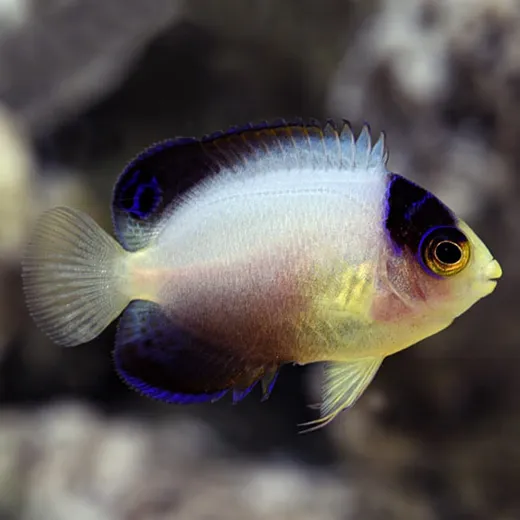
Multicolor Angelfish
The Multicolor Angelfish, also known as the Pastel Pygmy Angelfish or Many-colored Angelfish, is pale peach-orange to yellow. Black speckles on a background of blue highlight an area just behind the eyes. The dorsal and anal fins are blue-black while the caudal fin is yellow. In bright contrast to its other colors, there is a horizontal swatch of silvery-white from mid-body to the caudal fin.
The Multicolor Angelfish needs a minimum of a 70 gallon tank with lots of hiding places and live rock for grazing on microalgae. It does best in subdued lighting, since in the wild, it is a deep-water swimmer. The Multicolor Angelfish may nip at fleshy stony and soft corals (sessile invertebrates) and clam mantles. It is sensitive to copper-based medications.
Diet includes a variety of algae-based foods, high-quality flake food, and frozen foods such as brine shrimp or mysis shrimp.
| Specifications |
|---|
| Species: Multicolor Angelfish (Centropyge multicolor) |
| Size: Up to 3 inches (7.5 cm) |
| Water Temperature: 72–78°F (22–26°C) |
| Water pH: 8.1–8.4 |
| Water Hardness: 8–12 dGH |
| Compatibility: Best with non-aggressive, similarly sized fish |
FAQ
What is the ideal tank size for a Multicolor Angelfish?
A minimum of 70 gallons is recommended to provide enough space and hiding places.
Does the Multicolor Angelfish require specific lighting?
It does best in subdued lighting, as it is naturally adapted to deep-water environments.
Can the Multicolor Angelfish be kept with corals?
It may nip at fleshy stony and soft corals, so it is not recommended for tanks with sensitive invertebrates.
Sonia Dyer –
The fish is beautiful with its unique color pattern. I’ve kept it in a 75-gallon tank with plenty of live rock and it’s very active. It doesn’t seem to bother the corals, though I’ve avoided soft corals. Feeds well on algae wafers and frozen foods.
Leonard Knox –
A striking addition to my reef tank. The silvery stripe is very noticeable. I keep it in a well-maintained tank with low lighting. It’s peaceful and doesn’t show signs of aggression.
Dominic Alsop –
The fish looks great, but I noticed it occasionally nips at a soft coral. I’ve since removed it and now keep it in a separate tank with no corals. It’s a good choice for experienced aquarists.