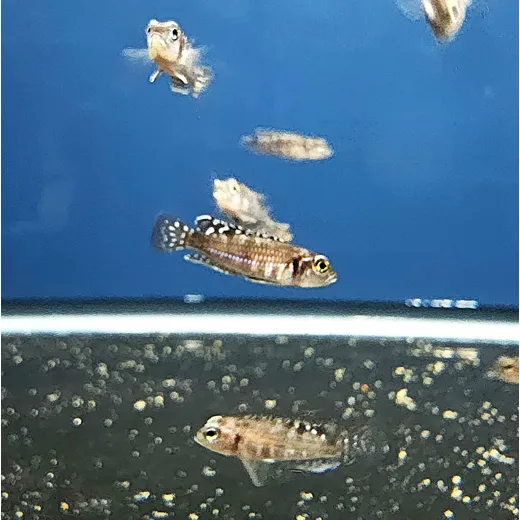
Common Name
Pearl Shell Dweller
Lamprologus stappersi
This is a Lake Tanganyika shell dweller prized for its pearly spotting, big personality, and true shell breeding behavior.
Origin and Habitat
Lamprologus stappersi is endemic to Lake Tanganyika, with records placing it on the west coast in the Democratic Republic of the Congo. It is associated with sandy areas where empty gastropod shells collect, and it uses shells as both refuge and breeding sites.
Shell patches act as the center of territories, with females occupying individual shells and males defending a wider area that may include multiple shells. These are clear, highly mineralized waters with gentle near shore movement, and the habitat is defined by sand, shells, and nearby rock structure.
Behavior and Care
| Parameter | Detail |
|---|---|
| Water Type | Hard, alkaline, clear water |
| Habitat | Sandy substrates with scattered shells and rock structures |
| Temperament | Aggressive males, peaceful with other species when properly sized |
| Breeding | Uses shells for nesting; females lay eggs in shells |
FAQ
What kind of environment does Lamprologus stappersi require in an aquarium?
Lamprologus stappersi requires a tank with sandy substrate, scattered empty gastropod shells, and nearby rock structures. The water should be clear, hard, and alkaline with gentle water movement, mimicking its natural habitat in Lake Tanganyika.
Can this fish breed in a home aquarium?
Yes, Lamprologus stappersi can breed in a home aquarium if provided with suitable shells for nesting. Females lay eggs in shells, and the species exhibits true shell breeding behavior.
Are males and females different in behavior?
Yes, males are more aggressive and defend a wider territory that may include multiple shells, while females typically occupy a single shell and are more focused on nesting and egg-laying.
Zoe Cameron –
The Pearl Shell Dweller is a striking fish with beautiful pearly spots. It’s active and territorial, which adds a lot of interest to the tank. I provided plenty of shells and sand, and the fish quickly established a territory. The breeding behavior is fascinating to watch.
David Morgan –
This fish is a true Lake Tanganyika dweller. It’s not shy and makes the tank lively. I had to be careful with male-male interactions, but with proper spacing, it works well. The shell use is natural and impressive.
Diana Mackenzie –
I’ve kept several species of cichlids, and this one stands out for its personality and breeding habits. The fish uses shells as both shelter and breeding sites, which is exactly what I wanted in a community tank.