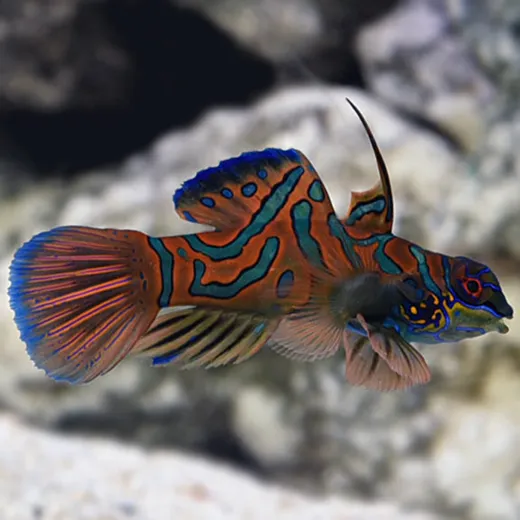
Red Mandarin Dragonet
The head and body of the Red Mandarin Dragonet are a mazelike combination of blue, orange, and red. Males may be distinguished from females by their extra-elongated first dorsal spine. The red variation of the Mandarin fish is a rare find in the industry and is extremely popular with aquarists because of its unusual beauty. Unlike the green mandarin, this red variant has much wider and more pronounced red stripes and red pectoral fins.
It should be kept in a well-established, 30-gallon or larger aquarium with plenty of live rock, live sand, and hiding places. It is moderately hardy in mature reef aquariums if given special care. It is not overly aggressive towards other fish, except for conspecifics.
It feeds on a variety of vitamin-enriched live brine shrimp, live black worm, and other small marine foods.
| Specifications |
|---|
| Species: Red Mandarin Dragonet |
| Size: Up to 3 inches (7.5 cm) |
| Water Temperature: 75–82°F (24–28°C) |
| Water pH: 8.1–8.4 |
| Compatibility: Peaceful with most reef fish; avoid with small, fast-moving species |
| Feeding: Live brine shrimp, live black worm, vitamin-enriched foods |
FAQ
What is the difference between male and female Red Mandarin Dragonets?
Males can be distinguished from females by their extra-elongated first dorsal spine.
What kind of tank setup is recommended for Red Mandarin Dragonets?
A well-established 30-gallon or larger aquarium with plenty of live rock, live sand, and hiding places is recommended.
What do Red Mandarin Dragonets eat?
They feed on vitamin-enriched live brine shrimp, live black worm, and other small marine foods.

Sue Kerr –
The red stripes are vibrant and stand out in the tank. My Red Mandarin has been thriving for over six months in a 40-gallon reef tank with plenty of live rock and hiding spots. It’s peaceful and doesn’t bother other fish. Only needs a small amount of live brine shrimp daily.
Victoria McDonald –
Beautiful fish with a unique color pattern. I noticed the male has a longer dorsal spine, which helps identify the sex. It’s not aggressive and adapts well to the tank environment after a few weeks.
Piers Edmunds –
The red variation is rare and truly eye-catching. I’ve kept it with a group of clownfish and it coexists peacefully. Feeding is simple—just a few brine shrimp twice a week. It’s a great addition to any reef setup.