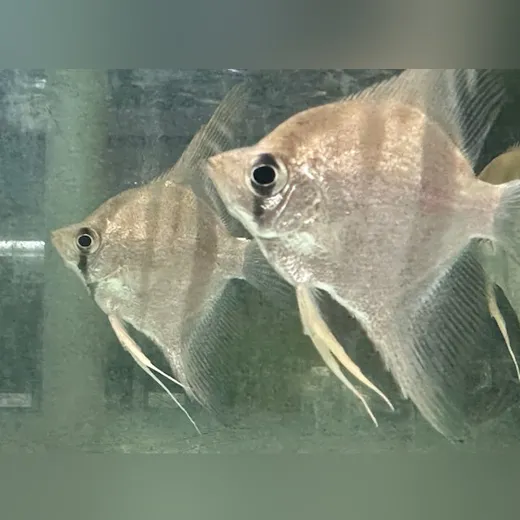
Santa Isabel Altum Angelfish
This wild angelfish is nicknamed “altum,” but it is actually a scalare and therefore a bit hardier than true altums. Nevertheless, wild Santa Isabels need temperatures above 77 degrees and pH below 7. Very adaptable to the aquarium, they stand out with their round body and bold black line through the eye. Named after the town of Santa Isabel on the Rio Negro.
Quick Facts
| Scientific Name | Pterophyllum scalare (wild form) |
|---|---|
| Origin | Brazil (Rio Negro, wild-caught) |
| Care Level | Moderate |
| Temperament | Semi-aggressive (territorial when pairing) |
| Adult Size | Up to 6″ long |
FAQ
What is the ideal water temperature for Santa Isabel Altum Angelfish?
The ideal water temperature should be above 77 degrees Fahrenheit.
What is the recommended pH level for this fish?
A pH level below 7 is recommended for Santa Isabel Altum Angelfish.
Are Santa Isabel Altum Angelfish aggressive?
They are semi-aggressive and can become territorial when paired with other angelfish.

Kimberly Clark –
The fish arrived healthy and looks vibrant. It has a striking black eye line and is active in the tank. Water parameters are stable, and it’s adapted well to my 55-gallon tank with proper temperature and pH control.
Christopher Young –
A beautiful addition to my community tank. It’s more resilient than I expected. I keep the temperature above 77 and pH under 7, which has helped it thrive.
Lucas McDonald –
The fish is very active and shows off its color well. I noticed it becomes slightly territorial when kept with another angelfish, so I now keep it alone or with non-aggressive species.