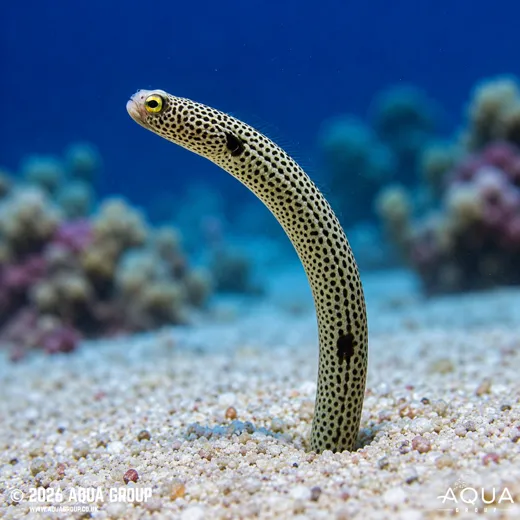
Spotted Garden Eel
A slender spotted eel that lives permanently in a vertical sand burrow, swaying in the current to pick plankton. Fascinating, and a genuine specialist.
Feeding
Planktivore. Requires small foods delivered into the water column in gentle flow – frozen mysis, enriched brine shrimp and cyclops, several times daily.
Compatibility
Peaceful and reef safe. Must be kept in a group of five or more, as isolated individuals rarely emerge or feed. Cannot be housed with boisterous tankmates.
Behaviour and personality
Extends from a sand burrow to feed and withdraws completely when startled. A colony swaying together is one of the best sights in a marine aquarium.
Before you buy
Three requirements, all essential: a very deep fine sand bed, a group of five or more, and a stable, slow-moving current.
| Specification | Detail |
|---|---|
| Species | Spotted Garden Eel |
| Feeding Type | Planktivore |
| Group Size Required | 5 or more |
| Water Flow | Gentle, slow-moving |
| Sand Bed Depth | Very deep fine sand |
FAQ
What kind of food does the spotted garden eel eat?
The spotted garden eel is a planktivore and requires small foods such as frozen mysis, enriched brine shrimp, and cyclops, delivered into the water column with a gentle flow several times a day.
Can I keep a single spotted garden eel alone?
No. The eel must be kept in a group of five or more. Isolated individuals rarely emerge or feed and will not thrive.
Is the spotted garden eel safe for a reef tank?
Yes, it is peaceful and reef safe when kept in appropriate group sizes and with suitable tank conditions.
Robert Watson –
The spotted garden eels are a stunning addition to my marine tank. After setting up a deep sand bed and adding five eels, they started swaying together beautifully. They feed well when I add small planktonic foods slowly. Very peaceful and don’t disturb other fish.
Jane Springer –
I was skeptical at first, but after following the group size and sand depth requirements, the eels became a highlight of my tank. They stay hidden most of the time but emerge to feed. The gentle flow is key to their feeding success.
Carl Parsons –
The colony behavior is mesmerizing. I’ve never seen anything like the synchronized swaying. My tank feels more alive now. I make sure to deliver food slowly and keep the current steady.