
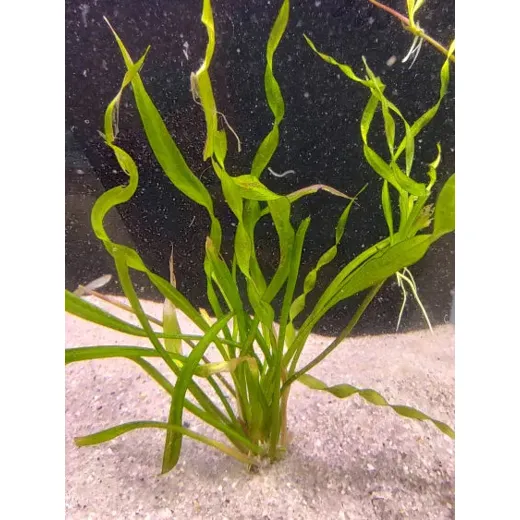
Its job in your tank: root feeder and midground accent.
Vesuvius sword (Echinodorus ‘Vesuvius’, now classed as Helanthium bolivianum ‘Vesuvius’) grows thin, tightly spiraled leaves about 10 inches tall. It sends out runners that make new spiral plants beside it.
How it fits the Father Fish Method
Father Fish has kept fish for more than 70 years, and his method has helped thousands of aquarists build tanks that run on biology instead of bottles. A layer of living soil sits under a sand cap and feeds rooted plants for years. You plant heavily on day one and skip the CO2, liquid fertilizers and root tabs. Then the plants, the soil and the tiny life in them balance the tank.
| Feature | Detail |
|---|---|
| Plant Type | Rooted aquatic plant |
| Leaf Shape | Tightly spiraled, thin |
| Height | About 10 inches |
| Growth Pattern | Spreads via runners |
| Role in Tank | Root feeder and midground accent |
FAQ
How does Vesuvius sword spread in the tank?
It spreads through runners that grow from the base and form new spiral plants beside the original one.
Does it require CO2 or liquid fertilizers?
No, it grows well without CO2 or liquid fertilizers when used in the Father Fish Method with living soil.
What is the recommended planting method?
Plant heavily on day one in a layer of living soil under a sand cap, following the Father Fish Method.
Chloe May –
Grew quickly in my tank with no added fertilizers. The spiral leaves are unique and add great visual interest. It spreads naturally through runners, making it easy to cover midground areas.
Gabrielle Powell –
Works well in my living soil setup. The plant stays healthy and doesn’t need extra feeding. The leaves are dense and give a nice texture in the middle layer.
Colin May –
I planted it on day one with the living soil and it has already produced runners. No CO2 or root tabs needed. It’s a solid choice for a biology-based tank.